
Your needs, this model
Does it fit your priorities?
If I allow an earlier machine, can I require manual Pulse control for textured-bag sealing?
Yes. The original A100 manual describes press-and-release Pulse control, with a separate Seal button to finish. You must watch the food and stop suction yourself.
Explore this need in the finder →Does the original A100 provide a complete textured-bag roll workflow?
Yes, with manual preparation: the guide shows sealing one end of a cut roll before filling and vacuum sealing the open end. It has neither built-in roll storage nor a built-in cutter.
Explore this need in the finder →Can I require a built-in bag cutter or internal roll storage?
No. The model-specific support page says the original A100 has neither. Plan to measure and cut a roll separately.
Explore this need in the finder →Can I use the original A100 to bag broth without first freezing it?
No. The exact manual says to pre-freeze liquids before vacuum packaging and warns against drawing liquid into the machine.
Explore this need in the finder →Does its impulse mode document continuous vacuum-and-seal batches?
No. Impulse mode is a heat-only seal without evacuation. The evidence does not establish unrestricted back-to-back full vacuum-and-seal cycles.
Explore this need in the finder →Does the reviewed package include reusable vacuum canisters?
No. The original A100 has an accessory port and the manual describes an external canister routine, but the manufacturer lists the hose as included and the canisters as separate.
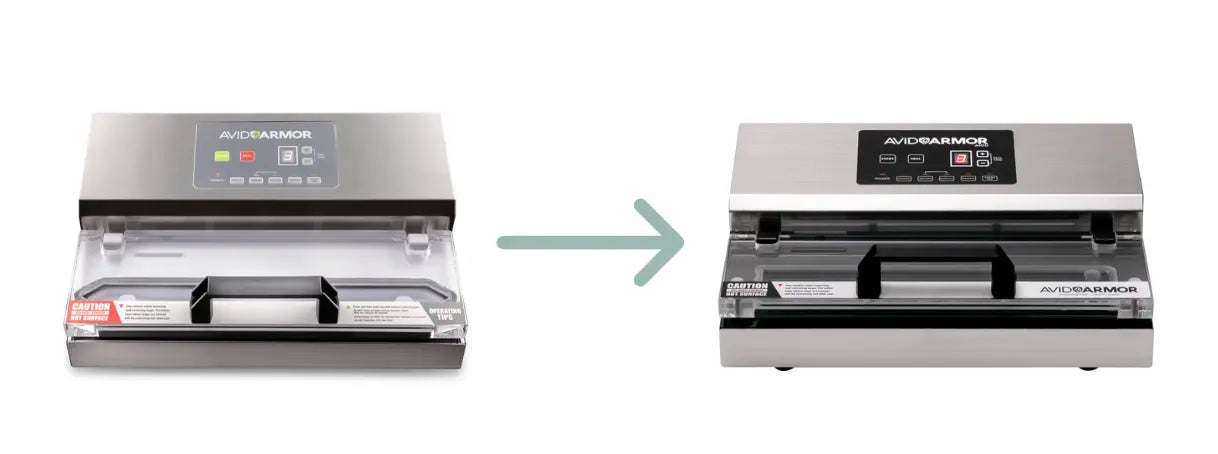
Explore this need in the finder →The Avid Armor A100 Original is an earlier external vacuum sealer with a distinctive strength: the operator can control suction with a manual Pulse button, then finish with a separate Seal control. It is not the A100 GEN 2. Avid Armor’s current support material keeps separate original-A100 and GEN 2 guidance, and its maintenance-kit page offers an explicit “A100 - ORIGINAL MODEL” selector. The maker’s “next generation” comparison describes GEN 2 as the successor. I found support and replacement parts for the original, but not a current new-machine offer for this exact version; treat this as an earlier-model reference, not a promise of stock or a new-unit purchase.
What the original A100 actually seals
The exact 12-page A100 manual linked by Avid Armor support describes an external bag routine. The filled bag stays outside the machine; its open end lies flat across the vacuum channel and seal bar. Although the manual labels the channel a “vacuum chamber,” this is not a chamber machine that evacuates the entire pouch inside a tank. Use compatible embossed or textured bags and rolls so air can travel through their channels. The A100 can make a custom-length bag from a roll by sealing one end and then vacuum-sealing the filled bag’s open end, but the maker says this original model has neither internal roll storage nor a built-in cutter. You need a separate way to measure and cut roll material.
The manual asks for at least three inches of headspace above the food. It also says to keep the mouth flat, inspect the finished seal, and remake a bag if the seam is spotty, wrinkled, incomplete or milky. Those steps matter more than chasing a headline suction number: the current model-specific sources do not establish a measured vacuum level, speed, maximum bag width or body dimensions for the original A100. Do not transfer a GEN 2 spec or a nominal seal-bar length into an unknown bag-capacity limit.
Pulse is useful when attention is part of the plan
For fragile foods, Pulse gives the user a stopping point that a fully automatic cycle does not. Press Pulse and control it in short bursts while watching the bag; once the desired amount of air is out, use Seal to complete the package. That can help avoid crushing items such as berries or soft baked goods, but it is an attended technique—not an automatic delicate-food sensor or a one-touch cycle to leave running. The A100 also provides an adjustable seal-time control. Avid Armor’s support guidance says its own bags generally use setting 3, and says thicker material may require a longer heat setting. A too-short or too-long seam needs correction, not repeated guesswork with food inside.
There is a separate impulse function for heat-sealing without vacuum. Avid Armor says that this mode allows repeated back-to-back heat-only seals. That is not the same as evidence that the machine can run continuous vacuum-and-seal cycles without pauses. If uninterrupted high-volume bagging is essential, require a maker statement for that full duty rather than treating a cooling fan or heat-only mode as proof.
Moist food still needs preparation
Pulse can be applied to liquid-rich foods to keep liquid from being pulled into the unit, and Avid’s current A100 support page gives a careful route for high-moisture proteins: pat excess moisture away, leave headspace, keep the seal zone dry, and monitor the bag. That is a route for prepared moist solids, not approval to pull a bowl of broth through an external suction channel. The exact manual says to pre-freeze liquids until solid before bagging and warns against liquid entering the machine. If soup, sauces or free-flowing liquid are a routine task, consider a chamber sealer with a verified liquid workflow instead. Vacuum packaging also does not replace refrigeration or freezing; the manual states this directly.
Accessories, storage and care
The original A100 has an accessory port. Its manual describes a compatible hose-to-canister process and a marinating cycle, but the current manufacturer FAQ says the included package has the hose and that canisters are not included. That distinction matters: the port does not make this a ready-to-use canister kit. The maintenance page still distinguishes original A100 parts from GEN 2 parts, which is useful if evaluating an existing machine, but replacement-part support does not establish that an original unit is sold new or that used inventory is in good condition.
Care is practical but should be consistent. Unplug before cleaning. The manual says to remove and wipe the drip tray and clean the channel, gasket and sealing area without immersing or spraying the appliance. Store the lid resting rather than forcing it closed, which can compress the gaskets. It also says the machine is for household use only, even though older promotional material used “commercial-grade” language. For a small kitchen workflow that can respect these directions, the included manual Pulse and impulse-only controls are meaningful. For a business schedule, verify the current manufacturer’s use classification and duty limits rather than relying on historical marketing.
Who should look elsewhere?
Choose another setup if a built-in cutter, internal roll storage, supplied canisters, verified free-liquid packaging, known counter clearance, or documented continuous full-bag batches are essential. The A100 GEN 2 adds a magnetized locking lid and other updated controls according to Avid Armor, while an A420 is a better comparison when integrated roll handling is a priority. A chamber machine is the more suitable category when cool, unfrozen liquid packaging is central. Before buying an older A100, confirm the label, condition, included hose and manual, replacement-part fit, and seller return terms. This assessment is based on the maker’s exact manual and current support pages, not hands-on testing; I make no claim about actual vacuum strength, seal life, noise, price or current availability.
Sources: Avid Armor’s A100 original-model FAQ, operation guide, impulse-seal instructions, high-moisture protein instructions, A100 GEN 2 generation comparison and A100 maintenance-kit model selector.
Key details at a glance
| Mechanism | external |
|---|---|
| Power and charging | The exact manual requires a cord and grounded outlet; its inspected text does not establish the U.S. input wattage or voltage label. The old manufacturer's comparison chart reports electrical figures, but its original page is no longer available and those numbers were not imported. |
| Operating interval | The exact manual documents automatic bag vacuum-and-seal, attended Pulse, Seal-only and impulse heat-only modes. Support says impulse mode can make back-to-back heat-only seals; full-cycle continuous vacuum-and-seal duty is not established. |
| Supplies and accessories | Use embossed/textured vacuum-bag material. The machine has no built-in roll storage or cutter. The manufacturer says an accessory hose is included, while compatible canisters are separate purchases; the accessory port also supports a canister marinating routine. |
| Care and storage | Unplug before care. The exact manual says to wipe the chamber, removable drip tray, gaskets and seal zone clean, never immerse or spray the machine, and store the lid at rest rather than forced shut so the gasket is not compressed. |
Use the exact model’s instructions for operating limits, supplied equipment and version differences.
Sources for this assessment
- Avid Armor A100 Suction Vacuum Sealer: How To & FAQs
- A100 User Manual-2019-WEB.pdf, linked by Avid Armor support
- How do I operate my new Avid Armor A100 suction vacuum sealer?
- How do use the impulse seal on my new Avid Armor A100 suction vacuum sealer?
- Avid Armor A100 high-moisture protein instructions
- Introducing the Next Generation: Avid Armor A100 | GEN 2 Vacuum Sealer
- A100 Vacuum Sealer Parts & Maintenance Kit
Find a process that fits your food.
Combine package type, moisture and essential conveniences, then read the operating limits.