
Your needs, this model
Does it fit your priorities?
If I allow earlier references, can I require roll storage, a cutter, a moist setting and manual Pulse together?
Yes. The exact A420 manual and model support document those features together. The storage compartment takes compatible rolls up to twenty-five feet long.
Explore this need in the finder →Does the liquid sensor qualify the A420 for unfrozen soup in vacuum bags?
No. The original guide says to freeze liquids solid before vacuum packing and prevent liquid being drawn into the machine.
Explore this need in the finder →Can I require a documented continuous-batch vacuum-and-seal capability?
No. A continuous vacuum-and-seal duty is not established; the exact manual recommends twenty seconds of cooling between cycles even though the listing advertises a fan.
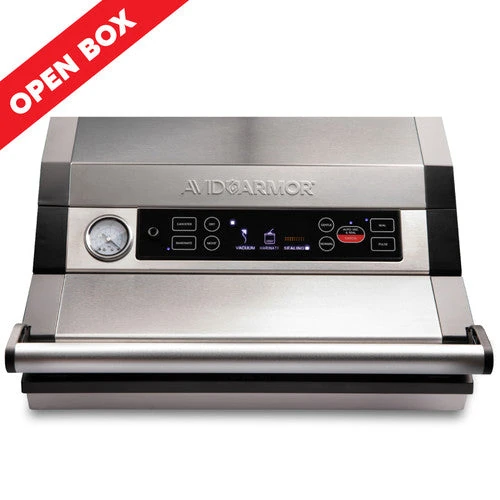
Explore this need in the finder →The Avid Armor A420 is an external suction sealer with built-in roll storage, a sliding cutter, dry and moist settings, and a dedicated Pulse control. It can suit someone who wants to make custom bag lengths without keeping a separate cutter on the counter. The current manufacturer catalogue presents it as an open-box offer. Check that exact condition and model rather than treating it as the wider A420XL or assuming new-condition stock is available.
What the open-box listing establishes
Avid Armor says returned open-box products are tested or inspected for proper operation and include all parts and accessories. The A420 listing identifies an accessory hose, an eleven-inch starter roll and a one-year warranty. Verify the actual unit's appearance and applicable purchase terms before ordering. The maker's inspection does not mean the appliance has never been used.
The A420 and A420XL are separate models. The A420's model-specific support specifies compatible rolls up to eleven inches wide and twenty-five feet long in its storage compartment. The A420XL instead advertises a sixteen-inch bar and a compartment for longer rolls. Do not use that wider machine's capacity, dimensions or parts as substitutes for this A420.
Bag making stays in one place
Lift the storage cover, pull out the desired material, lower the cutter support and slide the cutter across. The cut section still needs its first end sealed before you fill it. Place that end across the sealing tape, lock both sides of the handle and run Seal. After filling the resulting bag, the final vacuum operation needs the open end inside the vacuum channel.
The manual asks for at least three inches of headspace above the food. That margin gives you enough clean material to position the opening without a fold or food crossing the sealing path. Textured suction bags and rolls are required for evacuation. Smooth chamber pouches do not provide the same air path, even when their material can accept a heat seal.
Automatic modes and a real Pulse button
The exact A420 manual separates Dry and Moist sealing settings from Gentle and Normal vacuum choices. Moist gives a longer heat stage; Gentle is for softer food. These settings address different parts of the process. Choosing Moist does not stop an automatic vacuum from compressing a fragile item too far.
Pulse gives more direct control: press, hold and release to remove air gradually, then press Seal when ready. The manual says vacuum will be lost if Seal is not pressed within fifteen seconds after that pulse routine. Watch the portion and complete the sequence rather than assuming releasing Pulse has already sealed the bag. Seal can also interrupt an automatic vacuum cycle.
Liquid detection is a stop signal
The A420 has a liquid sensor in its vacuum channel. Its Water indicator prevents further operation until excess liquid is removed. That is a useful interruption, but the manual also warns against drawing liquid into the machine. A sensor does not turn this external sealer into an unfrozen-liquid packing system.
The guide tells users to freeze soup, broth or other liquids solid before vacuum packing. For fresh meat without pre-freezing, it describes a suitable absorbent barrier near the top of the bag. Follow those exact preparation instructions and keep the opening dry. Someone who regularly wants cooled soup sealed while still liquid should consider the chamber USV20 or USVXL, accepting their fixed interior size.
The fan does not remove the cooling interval
The current product page advertises an internal cooling fan. The original A420 operating guide nevertheless recommends twenty seconds of cooling between cycles and wiping residue from the channel after each bag. Plan that interval into a batch. Roll cutting, loading and checking seals are also part of the real workflow.
Unplug before cleaning. Use mild dish soap and a warm damp cloth, avoid abrasive products and do not immerse or spray the machine directly. Store with the lid closed but without locking or forcing it down, and do not stack objects on top. Compressing the foam gaskets in storage can interfere with the next vacuum cycle.
Accessories and control wording need care
The included hose connects to compatible canisters, but the canisters and jar fittings are separate. The marinate program uses a suitable external container and runs repeated vacuum-and-release stages; it does not heat-seal a bag. A hose alone does not establish a ready-to-use Mason-jar kit.
The current listing uses broad adjustable-seal-time language, while the linked original manual describes Dry and Moist rather than a numerical seconds control. Check the supplied panel and instructions if direct time entry is essential. Likewise, a named double-seal claim without a defined strip arrangement is not enough to promise two separately documented heat-seal lines.
Who should choose it?
The clearly identified open-box A420 suits ordinary external bag work when storage, cutting and Pulse are useful together. The A100 GEN 2 offers a different magnetic-lid and impulse-sealing routine but needs separate bag preparation. The A420XL is the wider alternative; a chamber machine is the more relevant change when unfrozen liquids determine the purchase.
Sources: exact open-box A420 listing, original A420 manual and model-specific roll and bag guidance.
Key details at a glance
| Mechanism | external |
|---|---|
| Power and charging | Exact A420 guide requires a grounded electrical outlet, no extension cord and indoor household use. Reviewed current sources do not provide exact US voltage or wattage. |
| Operating interval | Original guide recommends twenty seconds of cooling between cycles and wiping the channel after each bag. Pulse must be followed by Seal within fifteen seconds. The fan claim does not erase these instructions. |
| Supplies and accessories | Exact support permits compatible textured 8- or 11-inch rolls up to twenty-five feet in the compartment. Eleven-inch starter roll and hose supplied; canisters and jar attachments are separate. An explicit maximum bag width is not established. |
| Care and storage | Unplug; wipe with mild dish soap and a warm damp cloth, then dry. Do not immerse or spray directly. Store the lid closed without locking or forcing it down and do not stack objects on it. |
Use the exact model’s instructions for operating limits, supplied equipment and version differences.
Sources for this assessment
Find a process that fits your food.
Combine package type, moisture and essential conveniences, then read the operating limits.