
Your needs, this model
Does it fit your priorities?
Can I use the AVS7900 to vacuum and heat-seal custom-length textured bags?
Yes, for the documented earlier-model routine: use compatible embossed material, cut the roll with the separate removable cutter, seal one end, then place the filled bag opening flat in the channel. The exact current seller package and condition must be checked.
Explore this need in the finder →Can I require manual vacuum Pulse for delicate food?
Yes. The model-specific guide instructs the operator to pulse by pressing and releasing, then press Seal when the desired vacuum level is reached. This is an attended routine, not an automatic delicate-food claim.
Explore this need in the finder →Does the Moist setting make it suitable for free-flowing soup without freezing first?
No. Moist adjusts the seal time; the manual says to pre-freeze liquids before vacuum packaging.
Explore this need in the finder →Can I require a ready-to-use canister kit in the reviewed package?
No. The manufacturer documents an accessory port but says the hose and canisters are separate purchases.
Explore this need in the finder →Can I require continuous back-to-back sealing without a rest interval?
No. The manual recommends 60 seconds between cycles for best sealing results; continuous-batch capability is not established.
Explore this need in the finder →The AVS7900 is an earlier Avid Armor countertop suction sealer with a useful manual Pulse control, but its present shopping status is not established. The old product address now redirects to Avid Armor’s suction-sealer collection; that collection showed the A420XL rather than the AVS7900 when checked. Avid still hosts a model-specific support page and manual. Treat this as a capability review of an exact older model, not a promise that a new unit or any particular package is available.
It is an external bag sealer, not a chamber machine
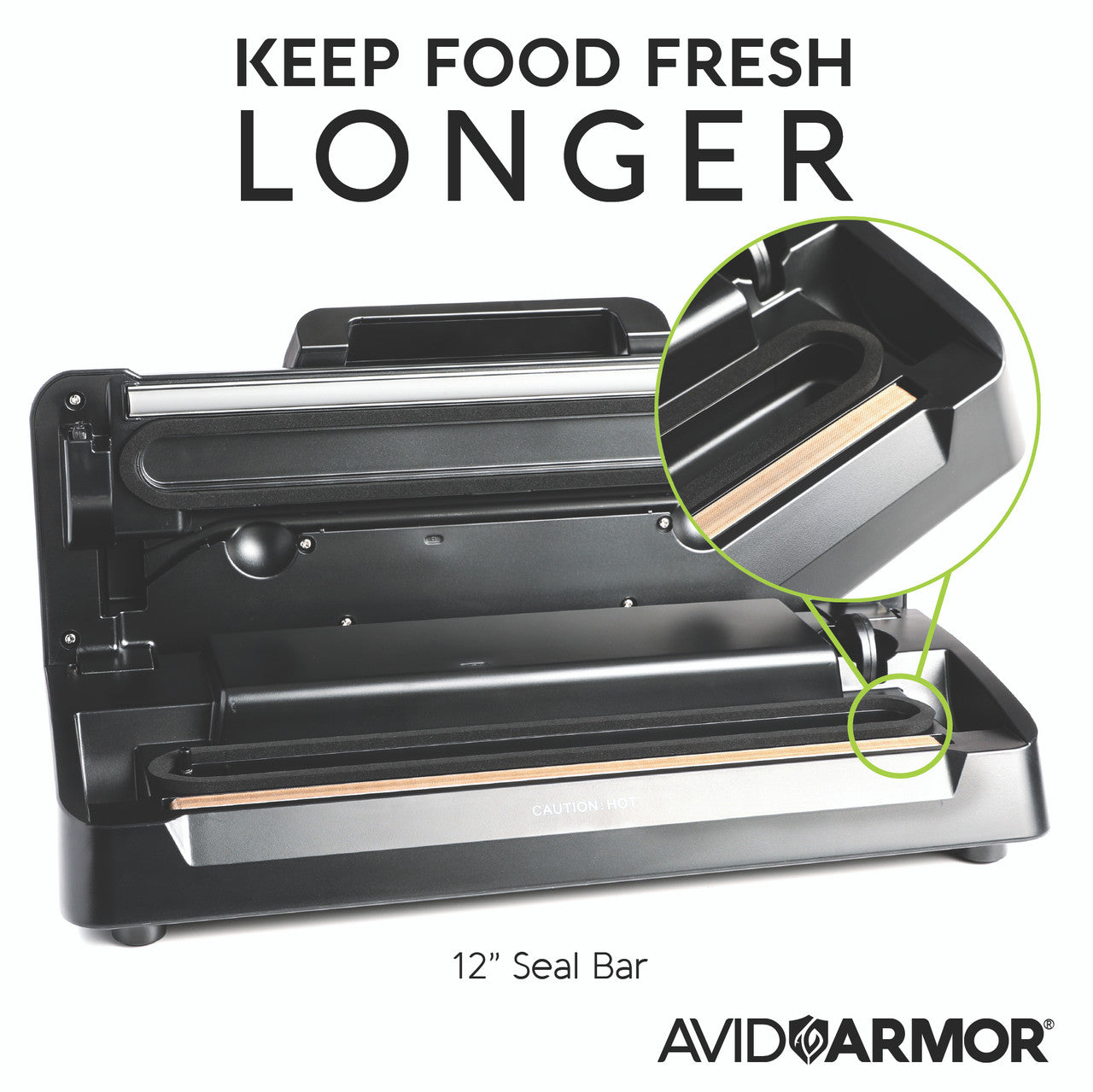
The manufacturer’s 12-page AVS7900 manual describes an open bag end set in a vacuum channel, then a locking lid, automatic vacuum-and-seal cycle and heat strip. That is the right arrangement for portions packed in compatible embossed or textured bags and rolls. It does not have a chamber where liquid can sit around a pouch, and the manual directs users to use Avid Armor bags and rolls. Avid’s support FAQ likewise says the machine needs embossed/textured material so air can travel through its channels. Smooth ordinary bags are not the same supply.
To make bags from a roll, the manual says to cut a length with the removable cutter, seal one end, then fill and vacuum-seal the open end. The FAQ confirms that the cutter is included, but the machine has no built-in roll storage and the cutter is a separate handheld accessory. Leave at least three inches of headspace above the food, lay the opening flat within the vacuum channel and lock the handle before starting. The control-panel lights show cycle progress; the manual still asks you to inspect the finished seal rather than assume a completed light sequence guarantees a good package.
Pulse is the useful control for delicate food
On this model, Pulse is a real control, not merely an automatic “soft” program. Press and release it to remove air in small steps; when the food has reached the amount of compression you want, press Seal to end vacuuming and close the bag. That gives you a way to stop before berries, baked goods or other crushable portions are squeezed as hard as an automatic cycle would squeeze them. It takes attention: you are watching the food and deciding when to stop, rather than loading a bag and walking away.
Dry and Moist are seal-time settings, not permission to pull free liquid through the pump. The manual describes Moist as a longer heat-seal time for moisture-rich foods. For soup, broth and other liquids, it tells you to freeze the liquid solid before vacuum packaging. Pulse can help manage liquid-rich food, but it does not cancel that freeze-first instruction. Vacuum packaging is also not a replacement for refrigeration, freezing or safe food handling.
Accessories and work rhythm change the fit
The support FAQ lists ten quart-size 8-by-12-inch bags and the cutter in the AVS7900 package. It also confirms an accessory port for compatible canisters and jars, but says the hose and canisters are sold separately. So an accessory port is an expansion route, not an included jar kit. Check the actual seller’s box contents if considering an old-stock or used unit; do not assume that a pictured hose, canister or replacement part is included. The manufacturer cautions against using this machine for Mylar bags.
The manual recommends allowing 60 seconds between cycles for best sealing results. That matters more than an advertised wattage or the word “automatic” if your normal job is a long run of packages. This is a pause-and-check appliance, not a documented continuous-batch workhorse. The removable drip tray and vacuum channel collect overflow, but the maker’s instructions still say to pre-freeze liquids and keep food out of the pump path. Unplug before cleaning, remove and wipe the tray and channel, and keep the gaskets and heated seal area clean and dry. The manual warns not to immerse or spray the machine.
Who should consider an AVS7900?
It suits someone who wants an older compact-style mains-powered sealer for occasional textured-bag work, values manual control over fragile food and is content to cut and store rolls separately. The model’s identity and operating guide are clear; current condition, availability and the contents of any surviving offer are not. If you find one, confirm the AVS7900 label, inspect the gaskets and seal tape, check the accessory inventory and follow the exact manual. No current sale or formal discontinuation date is established by the current redirect.
For a current Avid Armor option, the suction collection listed the A420XL at the time checked. That model is a different proposition: its maker describes a 16-inch dual-bag bar and built-in roll storage, while the AVS7900 manual documents a 12-inch single sealing bar and a handheld cutter. If an in-production seller listing, wider work surface or roll storage is essential, compare that exact configuration instead of assuming the older machine has been updated. If none of those features matter and Pulse is the deciding need, look for the exact AVS7900 model—not a generic “Avid vacuum sealer” listing—and verify the seller’s condition and included parts.
This assessment is based on the model-specific manufacturer manual and support material, not hands-on testing. I make no claim about actual vacuum strength, seal longevity, retail price, noise, bags per hour or present inventory.
Sources: Avid Armor’s AVS7900 FAQs, model-specific operating steps, AVS7900 user manual, current suction-sealer collection and AVS7900 gasket listing.
Key details at a glance
| Mechanism | external |
|---|---|
| Power and charging | Mains powered: the model-specific operating instructions say to plug in the power cord and the manual requires a grounded outlet with no extension cord. The exact electrical label was not verified from the current redirected product page; inspect the unit label before use. |
| Operating interval | The model-specific manual recommends at least 60 seconds between vacuum/seal cycles for best results. That is a concrete pause guidance, not a continuous-duty claim. |
| Supplies and accessories | Use Avid Armor-compatible textured/embossed bags or rolls as the manufacturer directs; Mylar is excluded. The manufacturer support FAQ documents 10 quart-size 8x12-inch bag samples and a hand-held cutter in the AVS7900 package. The cutter is separate from the appliance body and there is no roll storage. The accessory port is documented, but the hose and canisters are sold separately. Check a surviving offer for condition and exact included pieces. |
| Care and storage | Unplug before cleaning. Remove the drip tray, wipe the vacuum channel, gaskets and seal area clean and dry, and do not immerse or spray the machine. Store with the lid resting rather than forced shut so gaskets are not compressed. |
Use the exact model’s instructions for operating limits, supplied equipment and version differences.
Sources for this assessment
- Avid Armor AVS7900 User Manual
- Avid Armor AVS7900 Suction Vacuum Sealer: How To and FAQs
- How do I operate my new Avid Armor AVS7900 vacuum sealer?
- Avid Armor Suction Vacuum Sealers collection
- Avid Armor AVS7900 sealing-zone image linked from AVS7900 gasket listing
- Avid Armor AVS7900 Vacuum Sealer Gaskets

Find a process that fits your food.
Combine package type, moisture and essential conveniences, then read the operating limits.