
Your needs, this model
Does it fit your priorities?
Can I require roll storage, a built-in cutter and a dedicated moist-food setting together?
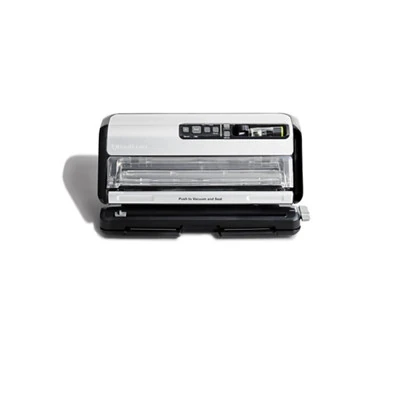
Yes. The FM5200 has a visible built-in roll bay, lower cutter and a selectable Dry/Moist control. Automatic moisture sensing is an additional feature.
Explore this need in the finder →Does its extra bag-making heat bar establish a double seal on every filled bag?
No. The documented second station prepares the next bag end. Two parallel closure lines on each filled bag are not established.
Explore this need in the finder →Can I require uninterrupted continuous-batch sealing?
No. The exact guide requires 20 seconds between seals, even though the roll station makes successive bag preparation more convenient.
Explore this need in the finder →The FoodSaver FM5200 is built around preparing a succession of custom-length bags. Its Express Bag Maker holds the roll in an open bay, seals the end of the next bag and lets you cut off the current one. A separate upper opening handles the filled bag's vacuum-and-seal cycle. For someone who uses rolls regularly, that separation is the reason to consider it; a buyer using mostly precut bags may have less use for the extra hardware.
Two working areas serve different stages
The current US package is 2159378. FoodSaver specifies a body 16.31 inches wide, 7.64 inches deep and 7.24 inches high. Measure access to both the lower bag-making bar and the upper vacuum window. A low overhanging shelf can be awkward even when the closed body fits, and a heavy filled bag needs counter support while its opening reaches the upper channel.
The open roll storage makes remaining material visible. It also leaves the roll as a distinct part of the station rather than hiding it behind a door. This layout makes sense on a counter where you can face the controls and pull bag material forward. Compare the enclosed roll arrangement on the V4440 if you prefer an upright appliance with a covered supply compartment.
Express Bag Maker needs a short learning sequence
For the first bag, open the lower seal-and-cut bar, fit the roll from the side and pull its material to the marked line. Close the bar and turn the lever to Seal. Wait for the sealing light to finish before using the upper window. That first step establishes the end seal from which later bags can be pulled.
Then unlock the lever, draw out the required length, turn back to Seal and slide the cutter across. This prepares the end of the next bag while releasing the one you are about to fill. Leave the instructed three inches above the contents when measuring a length. If you forget that allowance, a neatly cut bag can still be too short to load properly after food is inside.
The second heat-sealing station supports this bag-making sequence. It should not be confused with making two parallel closure lines on every filled pouch. The practical benefit is less repeated end-seal preparation, especially across similar portions. It does not remove the need to inspect each finished bag or prepare an appropriate length.
The filled bag uses the upper activation bar
Insert the open end through the bottom of the vacuum window into the drip tray, then push and release the Vacuum and Seal Bar with both hands. The window closes automatically and holds the bag for evacuation and sealing. Keep the closing path clear and do not force the window. This is a different trigger from simply feeding a bag into the V4440's automatic sensing channel.
The panel includes a selectable Dry/Moist setting and an early Seal button. Moisture sensors can also detect liquid in the tray. A dedicated manual Pulse mode is not listed: early sealing ends evacuation and starts the seal. If controlling vacuum in short bursts is a frequent requirement, compare the NESCO VS-12P before choosing the FM5200 for its roll-handling convenience alone.
Accessory use stays beside the powered base
The retractable handheld fitting works over compatible zipper-bag valves and connects to appropriate separately purchased accessories. Its Marinate control runs an approximately twelve-minute sequence with a compatible container. This is a tethered fitting, not a removable battery pump, and the current starter contents do not establish an included canister or jar-sealing kit.
FoodSaver's two package descriptions disagree about the starter roll's dimensions and the number of gallon zipper bags. Confirm those consumables on the box rather than choosing the machine because of one disputed count. The important machine-level distinction is that both open-end heat bags and valve bags have supported routes. Follow the actual bag's storage directions; the linked guide's zipper-bag section specifies pantry and refrigerator use.
Convenient bag making does not mean continuous duty
The manual calls for 20 seconds between seals. Use that interval for filling and labeling rather than treating the lower roll station as permission to run continuously. It also directs the user to freeze free liquids solid before vacuum sealing them in bags. A Moist setting manages prepared moist food; it is not the separate liquid-packing capability offered by some other machines.
After use, unplug and cool the appliance, empty the removable drip tray and wash it by hand or on the dishwasher's top rack. Wipe the fixed gaskets in place; do not pull them out. Clean and air-dry the handheld reservoir separately, and leave the lower lever unlocked for storage. Choose the FM5200 for recurring custom-length bag work when its two-stage layout fits your counter. For occasional precut portions, the FM2000 offers a simpler routine with less equipment to store.
Key details at a glance
| Mechanism | external |
|---|---|
| Power and charging | The current US 2159378 specification is 126 W. The upper bag channel, lower bag-making station and tethered fitting use the mains-powered base. |
| Operating interval | Wait at least 20 seconds between seals. Automatic bag handling and convenient roll preparation do not establish continuous duty. |
| Supplies and accessories | Current 2159378 package lists roll material, quart and gallon heat-seal bags, quart and gallon zipper bags and a retractable fitting. Its two lists disagree on roll dimensions and gallon zipper-bag count; confirm those consumables on the carton. No canister or jar-sealing kit is listed. |
| Care and storage | Unplug and cool before wiping the non-removable gaskets. Empty the removable tray after use and hand-wash or put it on the dishwasher top rack; dry before refitting. Wash and air-dry the handheld reservoir. Leave the lower lever unlocked for storage. |
| Confirmed closed body width | 16.31 in |
Use the exact model’s instructions for operating limits, supplied equipment and version differences.
Sources for this assessment
Find a process that fits your food.
Combine package type, moisture and essential conveniences, then read the operating limits.