
Your needs, this model
Does it fit your priorities?
Can this exact older Harvest Guard evacuate and seal a dry portion in an external vacuum bag?
Yes. The 65-1001-W booklet documents Vacuum & Seal for a compatible external vacuum bag. Use the stated headspace, keep the vacuum port clear and leave the lid open for the required interval between bags. It is an earlier model, so the finder includes it only after you opt into earlier references.
Explore this need in the finder →Can the Normal/Extended control be used for a maker-prepared moist solid without treating the unit as a liquid sealer?
Yes. The manual says the switch changes seal time for thicker bags or bags with moisture and gives preparation guidance for high-moisture foods. That is not a separate liquid program; free liquid and soup should not be inferred from the seal-time switch.
Explore this need in the finder →Does the exact 65-1001-W establish an integrated cutter, an 11-inch bag opening, or a free-liquid vacuum route?
No. The booklet describes sealing bags cut from roll stock but does not document a built-in cutter or maximum bag width. It gives no direct free-liquid procedure. Unknown width cannot satisfy an essential minimum.
Explore this need in the finder →Weston · Harvest Guard Vacuum Sealer · exact U.S. model 65-1001-W · earlier model
The Weston Harvest Guard 65-1001-W is best understood as a specific earlier external-bag sealer, rather than as a stand-in for every Weston machine. Weston’s archive lists this exact model, and its product record names the Harvest Guard Vacuum Sealer_65-1001-W. That record shows web availability as RUNOUT and no available inventory; it does not prove that no used or leftover unit exists, nor does it promise a new one. The U.S. Use & Care booklet prints the same model number. It describes a corded appliance that evacuates a compatible bag in a shallow channel beneath the lid while the food-filled part stays outside. This is not a chamber machine that encloses the whole pouch.
What the controls actually do
The booklet identifies Vacuum & Seal, Seal, Vacuum Only/Accessory and Cancel, plus a Normal/Extended seal-time switch. Vacuum & Seal draws air from a suitable external bag and then closes its open end. Seal closes a clean bag mouth without first evacuating it, which is useful for making the end of a roll-cut bag. Vacuum Only/Accessory is for an external accessory or for watching a delicate item while air is removed; it is not named Pulse. If you want a distinct pulse button for repeatedly starting and stopping vacuum, do not count this control as one.
The Normal/Extended switch adjusts how long the heat seal runs for thicker bags or bags with moisture. That can help a prepared moist solid get a longer seal at the bag mouth, but it is not a separate wet-food vacuum mode. The manual suggests freezing soft, airy or high-moisture food before packing and, where appropriate, putting a paper towel above moist or powdery food. It does not give this model an upright-bag method, fill line or direct free-liquid routine. For broth, soup or loose sauce, do not infer a safe process from the word “Extended”; choose a model with an explicitly documented liquid workflow instead.
Bag preparation and pace
Use a compatible embossed or mesh-lined vacuum bag rather than an ordinary smooth storage bag. The manual calls for about two inches of clear material at the opening, a flat mouth centered in the vacuum channel, and an uncovered vacuum port. It describes preparing a bag from roll stock and then sealing its open end. The inspected instructions do not establish an onboard cutter, a roll-storage bay, a maximum bag width or a particular roll length, so those conveniences should not be assumed from roll-making instructions alone.
This is a machine for a deliberate bag-at-a-time routine, not a documented continuous production line. The booklet says to leave the lid open for at least 20 seconds between cycles. If thermal protection stops the machine, the instructions call for opening the lid and allowing roughly 20 minutes for cooling. That changes a large weekend portioning session: work in paced batches and do not treat the earlier word “Harvest” as evidence of a commercial duty rating. The inspected material specifies a grounded U.S. 120-volt, 60-hertz supply, but gives no wattage, vacuum level or measured cycle rate. Those missing numbers cannot be filled in with guesses or borrowed from another Weston model.
Who it fits, and who should pass
This model is most relevant to someone identifying a known 65-1001-W, evaluating an older household unit, or comparing the simpler Normal/Extended layout with newer wet-and-dry controls. Its plausible use is dry food and maker-prepared moist portions in compatible external bags, with an operator who accepts the stated pauses and can inspect the seal bar, lid, chamber and seals on the particular offer. It is an earlier reference in the finder, so ordinary “current machine” searches should not surface it unless earlier models are explicitly included.
It is a poor fit if your essential requirement is an integrated roll cutter, a guaranteed opening width, a built-in roll bay, a free-liquid method, a separately labeled Pulse control, supplied canisters or uninterrupted high-volume use. Those needs are either not documented or conflict with the manual’s cycle interval. The package list names ten 8-by-12-inch quart bags, but that list describes the original component set; it does not establish what a used machine includes. Check condition and included accessories rather than treating an old retail page as a present-day bundle. The booklet gives a one-year U.S./Canada warranty, but that historic statement is not a promise that an old unit remains covered or that service parts are currently available.
How the choice changes with your answers
If you select external bags, dry food and allow earlier models, the 65-1001-W can be considered for its documented Vacuum & Seal routine. If you select maker-prepared moist food, its seal-time switch and the manual’s preparation advice become relevant, but they still do not convert it into a liquid system. If you require unfrozen liquid, an onboard cutter, a minimum bag width or continuous batching, the missing or incompatible fact should remove it from consideration. A Weston 65-1601-W has a separate wet-and-dry control scheme, while the 65-1641-W has its own documented liquid workflow; those distinctions are reasons to compare their exact guides, not to transfer their features onto this Harvest Guard.
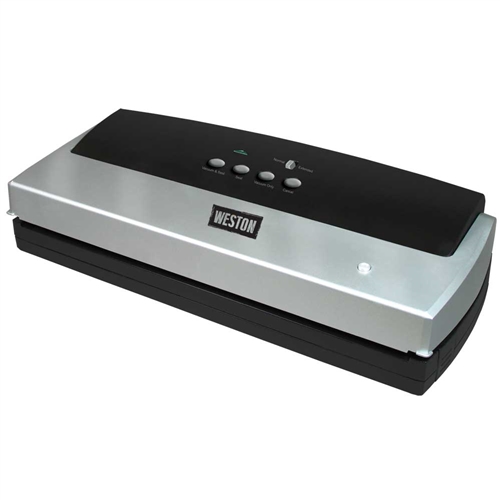
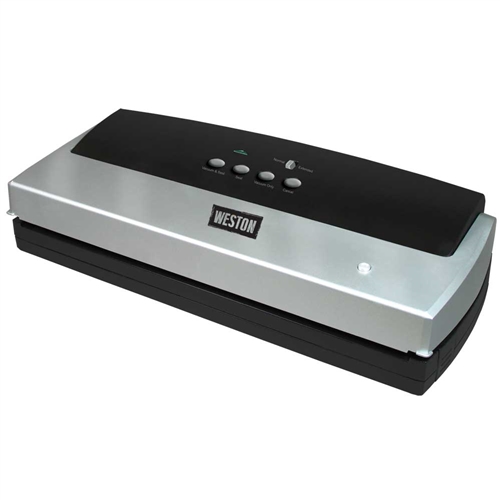
The official product image is assigned by Weston’s exact page to this SKU and its visible machine layout is consistent with the described external sealer; the image does not show a readable SKU label, and Weston does not state whether it is a photograph or render. The model evidence comes from the product page, archive and cover-identified manual—not from the image alone. Before buying an older unit, verify its label, operation, seals, cord, bag compatibility and actual package contents. If your needs depend on an unknown width, direct liquid handling or current parts, this record is not enough to establish that the machine meets them.
Sources: Weston’s exact product record, vacuum-sealer archive, and 65-1001-W Use & Care booklet.
Key details at a glance
| Mechanism | external |
|---|---|
| Power and charging | The exact 65-1001-W booklet specifies a standard 120 V, 60 Hz wall outlet. No wattage is given in the inspected product/manual material. Electrical supply is not a suction, speed or sealing-strength measurement. |
| Operating interval | The exact manual calls for at least 20 seconds between cycles with the lid open. If the thermal protector shuts the sealer down, open the lid and let it cool for about 20 minutes. This is not a continuous-batch rating. |
| Supplies and accessories | The original component list names ten 8 x 12 inch quart vacuum bags, but this is not a promise about the contents of a used or old offer. The manual recommends vacuum bags with embossed or mesh lining and describes making roll bags by cutting roll stock to length; it does not establish a built-in cutter, storage bay, maximum bag width, roll dimensions or supplied canister kit. |
| Care and storage | Unplug and let the machine cool fully. Wipe the plastic vacuum chamber, lid and outer surfaces with a damp cloth or paper towel; do not immerse, rinse under a tap, spray cleaner into the vent or use abrasive cleaners. |
Use the exact model’s instructions for operating limits, supplied equipment and version differences.
Sources for this assessment
Find a process that fits your food.
Combine package type, moisture and essential conveniences, then read the operating limits.