
Your needs, this model
Does it fit your priorities?
Can this exact Weston configuration vacuum-seal maker-described soups or purees in a heat-seal bag?
Yes, with the separate LIQUID VAC & SEAL procedure: place the sealer on its roll caddy, stand the bag upright, stay below the halfway/MAX line, leave at least 3 inches of headspace, and allow the longer cycle plus 30-second cooldown. No viscosity or maximum-volume number is published.
Explore this need in the finder →Can I make a custom dry-food bag from the included 11-inch roll without a separate cutter?
Yes. The exact booklet lists one 11-inch roll and a roll-storage caddy with a sliding cutter. Dry cycles still need a 20-second pause.
Explore this need in the finder →Does the 65-1641-W include a Pulse control for delicate contents?
Yes. The booklet labels a PULSE/CANCEL button and directs the operator to hold it until the desired air has been removed, then press SEAL. This manual sequence is distinct from the automatic dry and liquid vacuum programs.
Explore this need in the finder →Is a standard canister included just because the sealer has an accessory hose?
No. The manual says special canisters and zipper bags are not included; the hose/port alone is not a complete supplied-canister setup.
Explore this need in the finder →Can I require no cooling pause between bags on the 65-1641-W?
No. The exact manual asks for 20 seconds between dry cycles and 30 seconds between liquid cycles, so continuous-batch operation is not established.
Explore this need in the finder →Weston · 2-in-1 Liquid and Dry Vacuum Sealer · exact model 65-1641-W
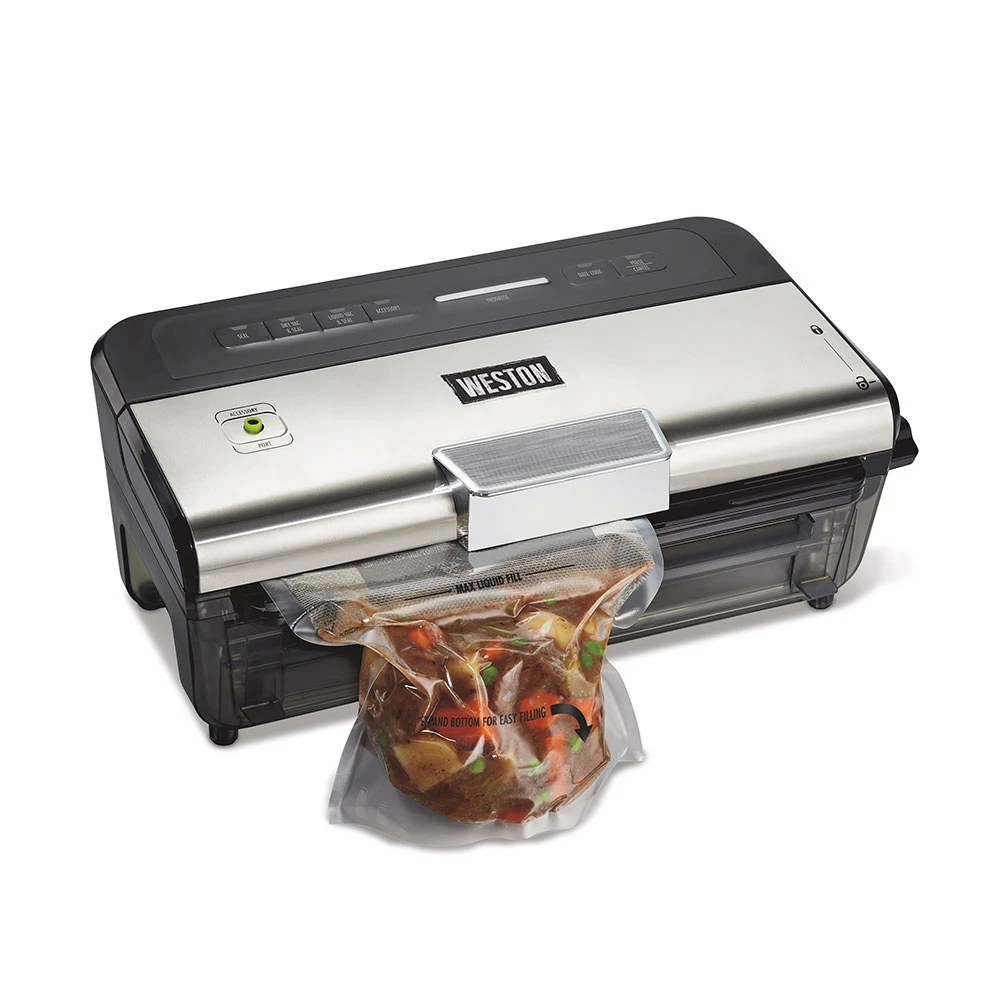
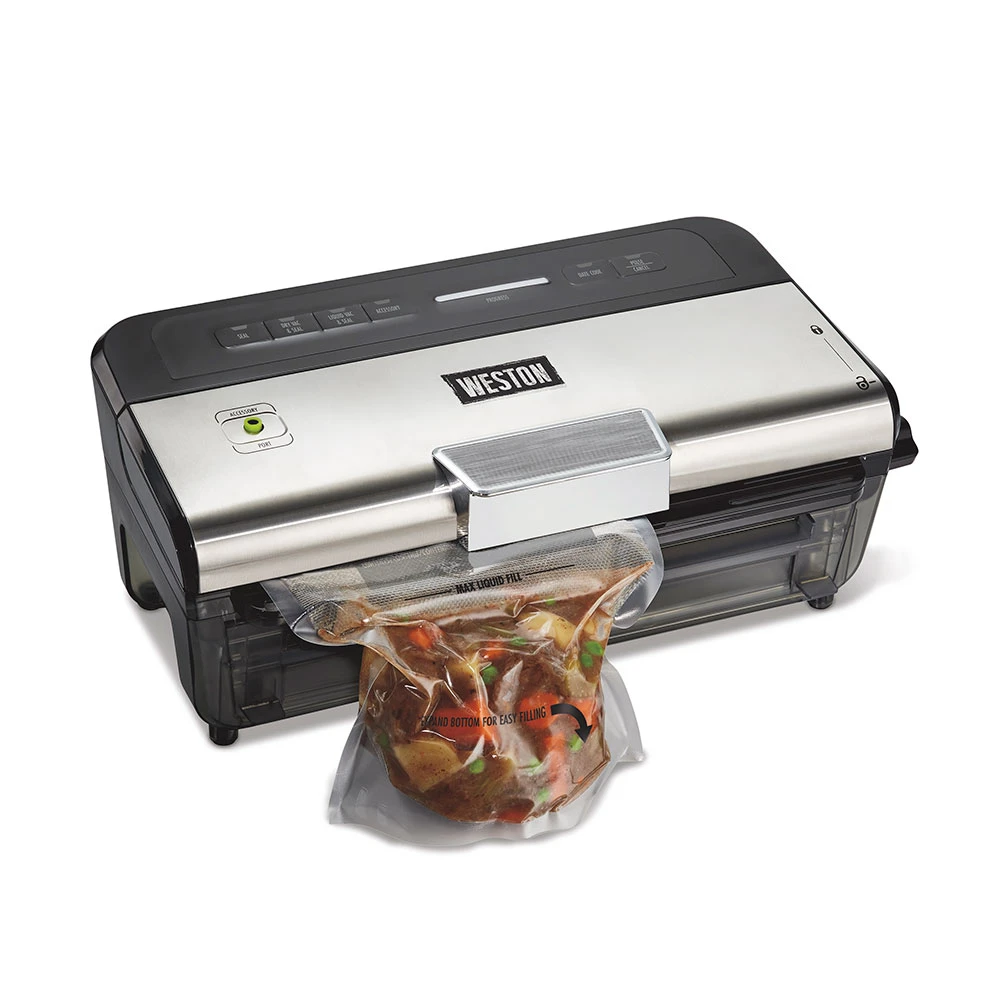
The Weston 65-1641-W is a corded external bag sealer for cooks who want more than one button for ordinary dry portions. Its exact VC04 manual and Weston product page document distinct DRY VAC & SEAL and LIQUID VAC & SEAL routines. The product page names soups, stews and purees; the manual adds the setup rules that make that capability usable. This is not a chamber sealer: the food-filled part of the bag remains outside the machine while the open end enters the vacuum channel.
The useful distinction: two different bag routines
For dry food, this model combines evacuation and heat sealing in an automatic cycle. For liquids and moist food, Weston provides a separate liquid program rather than asking the owner to interrupt a general-purpose dry cycle and guess when to seal. That distinction matters if your meal-prep bags contain soup portions, stews or purees. The printed instructions are still bounded: place the sealer on top of its included roll caddy so the appliance is elevated, keep the filled bag standing upright, stop at the marked MAX LIQUID line (about half full), and leave at least 3 inches between food and the mouth. The manual says that the liquid cycle takes longer, calls for 30 seconds between liquid cycles, and notes that a small amount may enter the machine’s vacuum chamber and should be wiped out between runs.
Those directions make a real liquid workflow, not permission to fill a bag to the zipper and walk away. Weston’s page lists soups, stews and purees, but the manual does not publish a viscosity scale, an exact liquid-volume ceiling, or a promise that every thin broth will behave alike. Keep the bag mouth clean and flat; if your usual portions cannot stay upright or below the fill line, compare an actual chamber sealer instead of improvising around this external design. For perishable meat or poultry, vacuum packaging is not a room-temperature preservation method: FSIS says it must still be refrigerated or frozen. Follow the official FSIS guidance for the food being stored.
Roll handling is part of the package
The 65-1641-W’s roll caddy serves two jobs. It stores and cuts roll material for everyday dry bags, and it is the raised base the manual requires beneath the machine during liquid sealing. The exact guide lists one 8-inch roll, one 11-inch roll and six Easy Fill stand-up quart bags in the package. Its sliding cutter lets you make a custom bag length, and its date coder can stamp the month and day when enabled before sealing. The machine also has a PULSE/CANCEL control: for fragile foods or nonfoods, hold it to remove the amount of air you want, then press SEAL. That is an attended manual option, separate from both automatic programs.
The practical gain is a package that is ready to begin rather than a bare pump requiring a separately sourced roll holder. The limit is that this remains a textured-bag workflow: the manual requires heat-seal vacuum bags with a textured side for airflow and rejects ordinary household plastic bags. It lists compatible bags up to the included 11-inch roll width, but it does not give a maximum finished pouch length. A hose and accessory port are also present, though the booklet says that compatible canisters and zipper bags are not included. If you need a ready-to-use canister in the box, do not count the hose as one.
Choose the program, then pace the batch
For dry portions, use the dry program and allow at least 20 seconds between cycles. The liquid program’s 30-second pause is longer. Neither the dual-stage vacuum description nor the presence of a roll bay establishes continuous-batch operation, and the maker supplies no bags-per-hour rating. That makes this a better fit for planned family portioning than an uninterrupted processing line. A date coder may help mark the contents, but it does not replace clear labeling or safe refrigeration and freezing.
The manual prints a 120-volt, 60-Hz, 170-watt rating for the exact 65-1641-W. Treat 170 watts as an electrical input figure, not as evidence of suction power or a faster cycle than another model. The exact manual describes a five-year limited warranty for products purchased and used in the United States and Canada; its printed coverage conditions still apply.
Care and ownership limits
Unplug the appliance and let it cool before wiping the exterior and vacuum chamber with a damp cloth or paper towel. Do not immerse it. After a liquid run, check the chamber and wipe away any collected moisture before the next bag. The manual also says to store the machine with its lid unlocked so the chamber seals are not left compressed. The hot sealing parts deserve care while loading bags; the booklet cautions against operating without the seal-bar tape in place.
Some useful measurements remain unknown in the exact materials reviewed: closed body dimensions, weight, an operating-duty rating, a maximum liquid volume, and a numeric sauce-thickness threshold. If a countertop clearance, heavy daily batch or highly specific liquid range is essential, do not treat an absent specification as a pass.
Who should choose it?
Choose the 65-1641-W when you will actually use both automatic food routines, want the included cutter and roll storage, and can follow the upright, half-full liquid procedure. Its fit changes sharply with the questionnaire: a liquid-bag need points toward its dedicated program; a supplied-canister requirement does not, because those vessels are sold separately; a no-pause batch requirement rules it out; and a demand for more than an 11-inch roll is unsupported. For mainly dry bagging with no need for its liquid kit, compare the Weston Pro-1400 65-0301-W or Pro-1100 65-0650-W on their own controls and cycle limits. If filled pouches must sit inside a chamber rather than hang outside it, compare the Avid Armor or Anova chamber assessments and verify the exact chamber size and bag instructions.
Key details at a glance
| Mechanism | external |
|---|---|
| Power and charging | The exact VC04 rating table lists model 65-1641-W at 120 V, 60 Hz and 170 W. This electrical input rating does not measure suction, speed or sealing strength. |
| Operating interval | The exact booklet calls for at least 20 seconds between dry cycles and 30 seconds between LIQUID VAC & SEAL cycles. The liquid program runs longer; a separate pulse/cancel button is for attended manual vacuuming, not a claim of continuous production duty. |
| Supplies and accessories | The exact guide lists one 8-inch roll, one 11-inch roll and six Easy Fill stand-up quart bags; it diagrams an onboard roll caddy and cutter. Use heat-seal vacuum bags with at least one textured side, not ordinary household plastic bags. The accessory hose/port is supplied, but compatible canisters and zipper bags are not. |
| Care and storage | Unplug and let the machine cool before wiping the outside and vacuum chamber with a damp cloth or paper towel. A little liquid in the chamber may be normal during the liquid routine; wipe it between cycles. Do not immerse the appliance. Leave the lid unlocked for storage to protect the seals. |
Use the exact model’s instructions for operating limits, supplied equipment and version differences.
Sources for this assessment
- Weston 2-in-1 Liquid and Dry Vacuum Sealer exact product page, SKU 65-1641-W
- Weston Liquid & Dry Vacuum Sealer with Date Code Stamp Use & Care, type VC04, exact model 65-1641-W
- Official Weston product-page hero image for exact SKU 65-1641-W
- USDA Food Safety and Inspection Service: Can I keep meat in vacuum packages at room temperature?
Find a process that fits your food.
Combine package type, moisture and essential conveniences, then read the operating limits.