
Your needs, this model
Does it fit your priorities?
Can the exact 65-0650-W make custom dry-food bags from an 11-inch roll?
Yes. The model-specific booklet describes a roll holder and sliding cutter for material up to 11 inches wide. Use compatible textured bags, keep a clean sealing margin, and follow the documented cooling pause.
Explore this need in the finder →Does the exact 65-0650-W have a dedicated Pulse route for a liquid bag?
Yes. Its exact booklet names the Pulse control for liquids or delicate items, followed by Manual Bag Seal. No viscosity or maximum-fill limit is printed, so this is not evidence of unlimited soup capacity.
Explore this need in the finder →Does fan cooling let the 65-0650-W run continuous bags without a pause?
No. Its exact manual requires at least 20 seconds between cycles with the lid open; the fan does not cancel that interval.
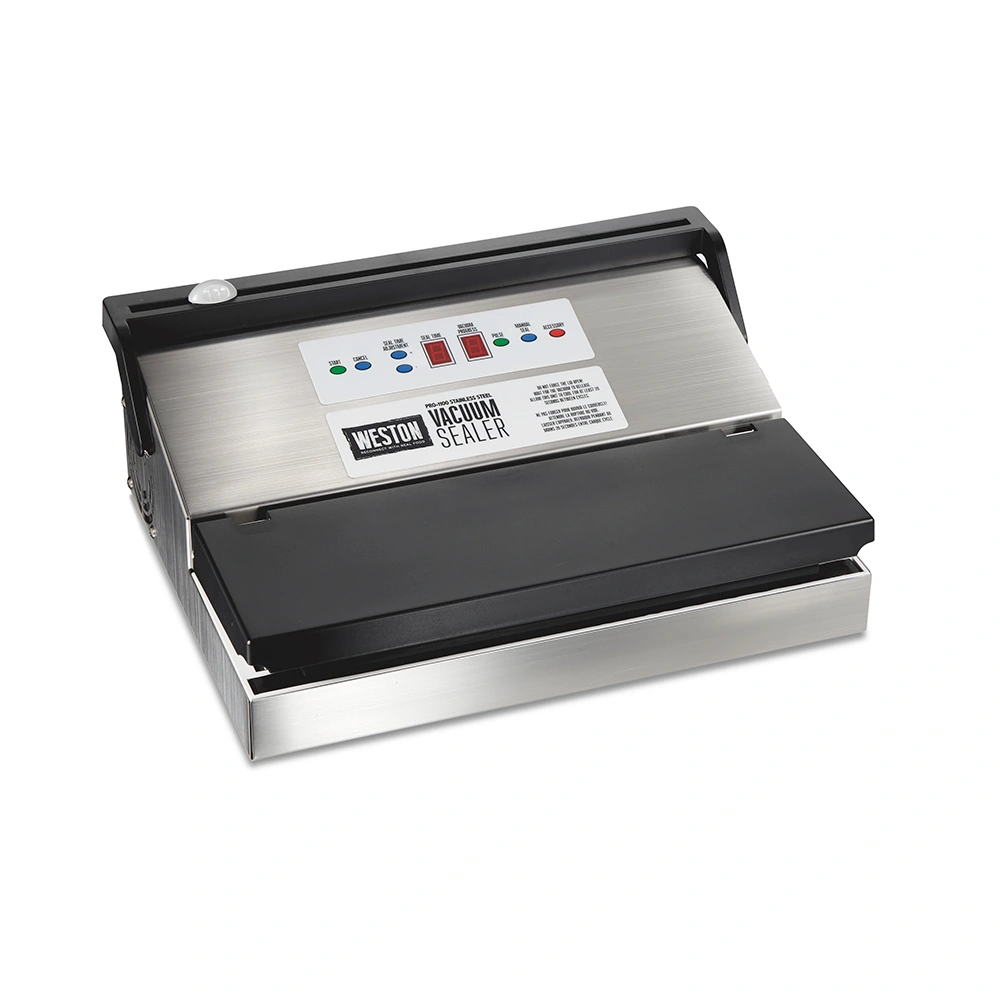
Explore this need in the finder →The Weston Pro-1100 Programmable 65-0650-W is an 11-inch external vacuum sealer with an integrated roll holder and sliding cutter, a rated 460-watt motor, and a choice between automatic vacuum-to-seal and manual controls. Its most useful distinction is not “programmable” as a label: the manual gives you a dedicated Pulse control for liquids and delicate items, plus adjustable heat-seal timing. It suits a household that wants to make bags to length and watch suction, provided a short cooling pause fits the session.
This is not a chamber machine. The filled part of an embossed or mesh bag stays outside while its open end rests at the suction area. Weston’s manual does document a pulse routine for liquids: press Pulse as needed to control extraction, then use Manual Bag Seal. It gives no viscosity or maximum-fill limit, so do not turn that statement into an unlimited soup capacity. If your requirement is a qualified thicker-sauce mode with stated boundaries, compare the FoodSaver Elite VS5960. If you routinely need to vacuum filled pouches with thin broth, compare a chamber configuration such as the Avid Armor USV20.
Roll handling is part of the everyday workflow
The exact 65-0650-W booklet lists a roll-holder assembly and cutter. Its instructions describe rolls up to 11 inches wide, with a sliding blade that cuts a custom bag length. That is practical if you alternate between small portions and long cuts that do not suit fixed-size bags. It also means the sealer occupies a larger work zone than a simple lid-only unit: leave room behind it to mount the roll support and room in front for the cut bag. Neither an 11-inch bag limit nor a closed-body measurement tells you how much clearance your counter needs while the lid is raised.
Use compatible embossed or mesh-lined vacuum bags; the manufacturer expressly says not to use ordinary household bags. Keep at least two inches of clear bag opening for the seal, keep the vacuum port uncovered, and make sure crumbs or liquid are not caught between the bag layers. When making a bag from a roll, create the first end seal before filling it. Weston’s instructions start seal time at three seconds, then have you test a couple of bags and adjust up or down in one-second increments if the seal is incomplete or melts through. That is a useful control for bag-material differences, not a substitute for checking each finished seam.
Pulse is different from simply ending a preset
The manual’s control list identifies both Pulse and Manual Bag Seal. Pulse lets you press repeatedly while monitoring a bag, then use Manual Bag Seal to finish; the booklet specifically names liquids and delicate items as reasons to control vacuum manually. Automatic mode instead runs until its vacuum progress reaches stage nine, then starts the selected heat-seal time. Those numbers represent vacuum stages, not seconds. Manual control helps avoid pulling moisture or fragile food toward the port, but it does not create a Moist preset or a guaranteed liquid-volume limit.
The same panel includes an Accessory button for compatible vacuum canisters, which the booklet says are sold separately. Do not assume an external port or button means a canister comes in the box. The main reviewed plan here is the supplied external bag routine; the exact package listing does not establish a complete ready-to-use canister kit.
Plan the pace instead of relying on the fan claim
Weston describes a fan-cooled 460-watt motor, but the exact booklet still tells the operator to wait at least 20 seconds between cycles with the lid open. It also explains that an overheat protector can stop the machine until it cools, about 20 minutes. For a freezer-prep day, pre-cut bags, label them before filling, arrange portions in reach, and use the pause to inspect the previous seal. Treating “fan cooled” as permission to run without the documented interval would defeat the instructions.
The exact manual identifies a grounded 120-volt, 60-Hz household outlet and a two-piston pump. The 460 watts is a printed electrical rating, not an independent measure of suction strength, speed, or seal quality. Weston currently lists this exact product page, but its Web Availability field says RUNOUT. That is neither a stock promise nor a dated discontinuation notice; check the complete 65-0650-W identity and package contents on any offer.
Cleaning, maintenance, and who should choose another route
Switch the machine off, unplug it, and let it cool before cleaning. The booklet calls for wiping the housing, lid, and plastic vacuum chamber with a damp cloth or paper towel; do not immerse it, rinse it under a tap, use abrasive cleaners, or damage the protective tape over the heating bar. The two chamber seals and the tape are wear items in the maintenance instructions. Perishable food still needs proper refrigeration or freezing after vacuum packaging.
Choose the 65-0650-W when roll cutting, an 11-inch bag width, and attended Pulse control matter more than a chamber’s liquid workflow. Choose a simpler external unit if you do not need the integrated roll station. Choose the Elite when your regular thick-liquid task depends on a stated viscosity and fill limit, or a chamber when the whole pouch must sit inside during evacuation. The current page identifies a Pro-1100 Programmable 65-0650-W, but the model’s stated 460 watts should not be treated as evidence that it outperforms the older 680-watt 65-0601-W; compare each exact control routine, condition, and instructions instead.
Weston’s exact 65-0650-W product page identifies the current model and its 460-watt, 11-inch configuration. The 68-page 65-0650-W use-and-care booklet contains the operating, maintenance, and safety details discussed here.
Key details at a glance
| Mechanism | external |
|---|---|
| Power and charging | Exact 65-0650-W rating: 120 V, 60 Hz, 460 W, grounded household outlet. The wattage is a printed electrical input rating, not an independent suction or sealing-speed measurement. |
| Operating interval | The exact manual requires at least 20 seconds between bag cycles with the lid open; its thermal protector may need about 20 minutes after overheating. Fan cooling does not remove the stated interval. |
| Supplies and accessories | Use compatible embossed/mesh vacuum bags, not ordinary household bags. Exact instructions support roll material up to 11 inches and list a roll holder and cutter. Compatible canisters are an accessory sold separately; a complete ready-to-use canister package is not established. Starter roll contents are not claimed. |
| Care and storage | Turn off, unplug, and cool before wiping the outside, plastic vacuum chamber, and lid with a damp cloth or paper towel. Do not immerse or rinse under a tap; avoid abrasives, direct spray into the fan vent, or peeling the protective seal-bar tape. |
Use the exact model’s instructions for operating limits, supplied equipment and version differences.
Sources for this assessment
Find a process that fits your food.
Combine package type, moisture and essential conveniences, then read the operating limits.