
Your needs, this model
Does it fit your priorities?
Will the exact Pro-1400 65-0301-W seal a compatible external bag up to 11 inches wide?
Yes. The Weston 65-0301-W page specifies bags up to 11 inches wide. The use-and-care manual requires compatible textured vacuum-bag material, not ordinary storage bags.
Explore this need in the finder →Does its Manual Seal button provide the same controlled Pulse routine as a dedicated Pulse button?
No. The VC14 has Start, Manual Seal, and Stop. Manual Seal begins sealing early after Start; the instructions do not describe repeated hold-and-release Pulse control.
Explore this need in the finder →Can the 65-0301-W be used for thin broth without monitoring?
That is not established. For high-moisture food the manual directs an attended early Manual Seal before liquid reaches the vacuum chamber; it gives no soup volume or viscosity limit.
Explore this need in the finder →Can I seal another bag immediately because the Pro-1400 has a fan?
No. The fan runs while the unit is on, but its manual calls for 20 seconds between cycles to avoid overheating.
Explore this need in the finder →Weston · current-reference machine · exact model 65-0301-W
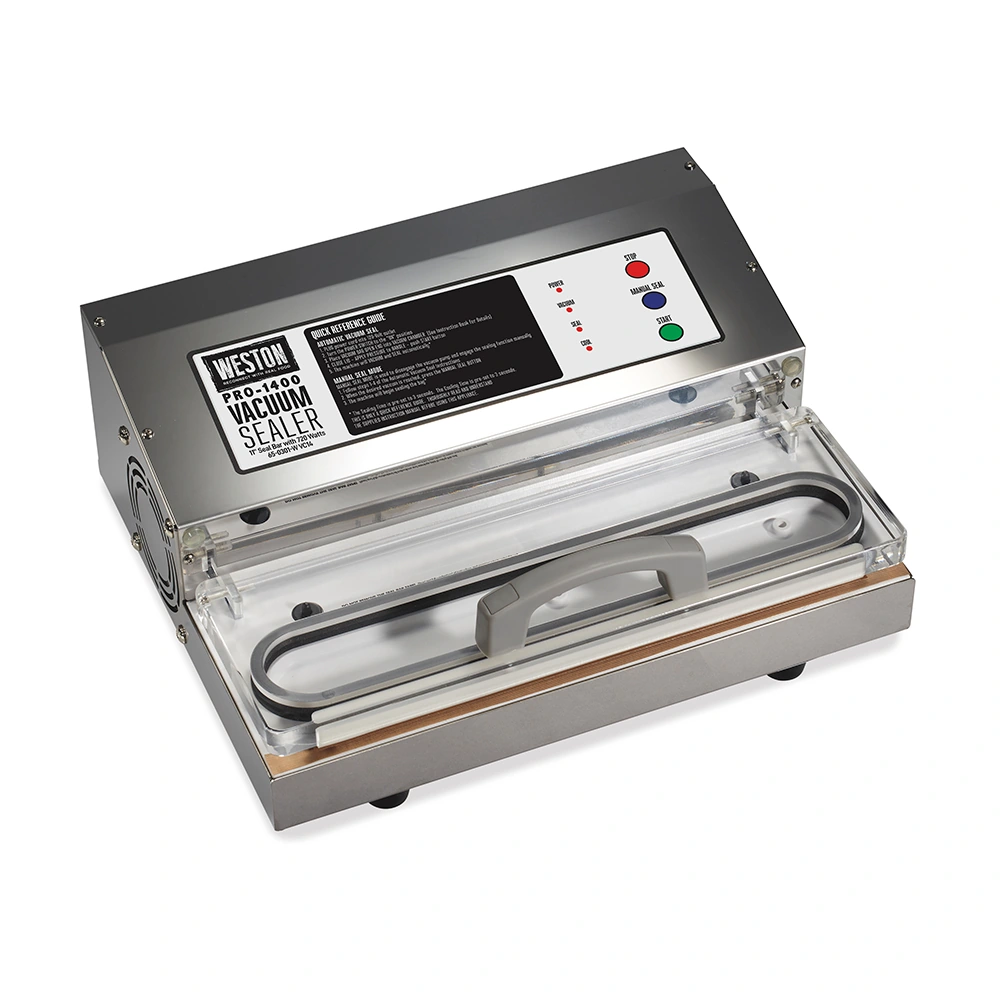
The Weston Pro-1400 is an external bag sealer for someone who values a broad, visible sealing area and a more controlled manual stop than a small one-button appliance. The official product page identifies the 65-0301-W and describes a fan-cooled motor, a double-piston pump, a 5 mm heat bar and bags up to 11 inches wide. Its exact use-and-care manual identifies type VC14 and a 120-volt, 60-Hz, 720-watt electrical rating. Those are maker specifications, not independent measurements of vacuum strength, speed or durability.
What the 11-inch external design means
The Pro-1400 draws air through the open end of a bag while the food-filled section remains outside the vacuum area. It is not a chamber sealer: the sealed bag itself is not placed in a sealed chamber. The manual calls for vacuum pouches or rolls 3 to 5 mil thick and, for an external sealer, an embossed or mesh lining. It specifically says not to use ordinary household storage bags. Bags may be up to 11 inches wide; the machine is a poor fit if your normal pouch stock is wider.
For a reliable seal, leave at least two inches of clear bag above the food, put the open end in the center of the vacuum chamber without covering the vacuum port, and smooth out folds. The manual advises keeping liquids, powders and small particles out of that port. A roll can be cut to a useful length, but the documents reviewed here do not confirm a built-in roll bay or cutter; plan to prepare that length separately rather than assuming the storage-and-cutter package sold under another Weston model is included.
Automatic start, with an early manual seal
The control panel is deliberately sparse: Start begins evacuation, Manual Seal ends evacuation and begins heat sealing early, and Stop interrupts the process. In automatic use, the unit seals when it reaches its preset vacuum pressure; the manual gives a four-second sealing stage. Manual Seal can be used after Start for delicate contents or to make a first seal across an empty bag. It continues pulling vacuum while the bar seals. That is not a Pulse button: there is no documented hold-and-release control for repeatedly metering vacuum pressure.
This distinction matters for moist food. The manual says to choose Manual Seal after the vacuum process has begun and seal before liquid enters the chamber. It does not establish a dedicated Moist setting, a safe soup volume, or a viscosity threshold for sauces. Treat the method as an attended early-stop routine for suitable contents, not a promise that the machine can safely evacuate free broth. If liquid handling or repeatable Pulse control is essential, compare a model whose exact manual explicitly documents that operating mode.
Repetitive work still has a limit
Weston says the internal fan runs while the power switch is on and describes the motor as fan-cooled for repetitive use. The manual nevertheless asks users to wait 20 seconds between cycles to avoid overheating; its approximately 10-second cooling phase is part of the cycle, not permission to start the next bag immediately. The manual also labels the appliance for household use only. The 720-watt input rating and fan should not be translated into an untested bags-per-hour claim or a commercial-duty recommendation.
That paced rhythm suits planned meal-prep sessions better than a production line. If you only package a few portions, the cooling interval is easy to build into the routine. If you want to prepare a large harvest in one uninterrupted run, look for an expressly documented duty specification, not just a high wattage figure or a fan grille.
Setup, storage and care
The clear lid and chamber make it easier to see the bag opening and watch the bag collapse, but they also need careful handling. Switch off and unplug before cleaning; let the hot seal bars cool, then wipe the exterior, plastic chamber and lid with a damp cloth. Do not immerse the unit, direct spray into the cooling-fan opening, use abrasives on the clear lid, or peel away the protective tape over the seal bars. The manual says to store the machine with its spacer in the chamber and the lid closed so the oval seals do not remain compressed. It also says not to store objects on top.
The exact manual describes replaceable chamber seals and seal-bar tape, and lists a two-year limited warranty for products purchased and used in the United States and Canada. That is a useful ownership detail, not a guarantee of free routine maintenance or long-term part availability.
Who should choose it?
Consider the Pro-1400 if you want a metal-bodied 11-inch machine with a see-through lid, an early manual seal and a fan-cooled design, and you are willing to keep a clean bag mouth and honor the 20-second pause. Its fit changes if you need built-in roll storage, a cutter, a dedicated Pulse control, wider bags, or an approved free-liquid workflow: those capabilities are not established for the 65-0301-W in the sources reviewed. The Weston Pro-1100 65-0650-W is a more relevant comparison when its documented roll/cutter and Pulse controls matter; the Pro-2100 65-0101 is worth comparing when the extra bag width matters. For liquid-filled pouches, compare an actual chamber model and verify the exact bag and food instructions.
Weston's public product record marked the 65-0301-W “RUNOUT” when checked on October 23, 2026. The page still showed an active product record, but that marker is not a stock promise or a formal discontinuation date. Treat this review as a reference to the exact machine and verify current availability before purchasing.
Key details at a glance
| Mechanism | external |
|---|---|
| Power and charging | The exact VC14 manual prints model 65-0301-W as 120 V, 60 Hz, 720 W. This is the electrical input rating, not an independent vacuum-strength or sealing-speed test. |
| Operating interval | The automatic seal stage lasts 4 seconds. The cycle has an approximately 10-second cooling/release phase, and the exact manual says to allow 20 seconds between cycles to avoid overheating. Its internal fan runs while switched on; that does not waive the pause. |
| Supplies and accessories | The manual requires 3-5 mil vacuum bags or rolls and recommends embossed or mesh-lined bags for out-of-chamber sealers; ordinary household bags are excluded. The exact product page specifies bags up to 11 inches wide. No starter-bag assortment, roll bay, or built-in cutter is established in the inspected sources; plan to cut roll stock separately. |
| Care and storage | Switch off, unplug, and allow the seal bars to cool before cleaning. Wipe the exterior, plastic vacuum chamber, and clear lid with a damp cloth. Do not immerse or rinse the unit, spray directly into the fan, use abrasives on the clear lid, or remove the protective seal-bar tape. Store with the spacer in the chamber and lid closed to protect the oval seals; do not store items on top. |
Use the exact model’s instructions for operating limits, supplied equipment and version differences.
Sources for this assessment
Find a process that fits your food.
Combine package type, moisture and essential conveniences, then read the operating limits.