
Your needs, this model
Does it fit your priorities?
Can the exact earlier Pro-2600 run a standard external heat-seal-bag cycle for dry portions?
Yes. The official Pro-series instructions show the bag placed in the lower chamber, then Start for automatic evacuation and sealing. The machine is an external-bag sealer, not a chamber pouch system. It is included only when earlier models are requested.
Explore this need in the finder →Does Manual Seal offer an attended way to stop evacuation when sealing a cool liquid bag?
The official instructions say to use Manual Seal when vacuum sealing liquids, and warn the operator not to draw liquid into the vacuum port. This is an attended bag routine, not a separately bounded soup/sauce program; the manual publishes no numeric viscosity or fill limit.
Explore this need in the finder →Can the word Pro-2600 or an old listing establish a 12-inch bag opening or continuous production duty?
No. Weston calls the seal bar extra-long and extra-wide but gives no number in the exact product record. The Use & Care document requires a 20-second pause between cycles, so this is not a documented continuous-duty configuration.
Explore this need in the finder →Weston · Pro-2600 Stainless Steel Vacuum Sealer · exact U.S. model 65-1301-W · earlier model
The Weston Pro-2600 65-1301-W is an earlier external-bag sealer for an owner who wants to control when evacuation ends, rather than relying only on a fully automatic vacuum point. Weston’s exact product record identifies the Pro-2600 Stainless Steel Vacuum Sealer and SKU 65-1301-W, and describes its seal bar as extra-long and extra-wide. The record shows RUNOUT and unavailable web inventory, while Weston’s archive also lists this model. Those facts make it an earlier reference, not a promise that a new machine is stocked or a formal discontinuation date. The page provides no numeric maximum bag width. Listings elsewhere disagree, so a shopper who needs a specific opening should verify the individual machine and its manual instead of assuming 15 or 16 inches.
Automatic start, operator-timed sealing
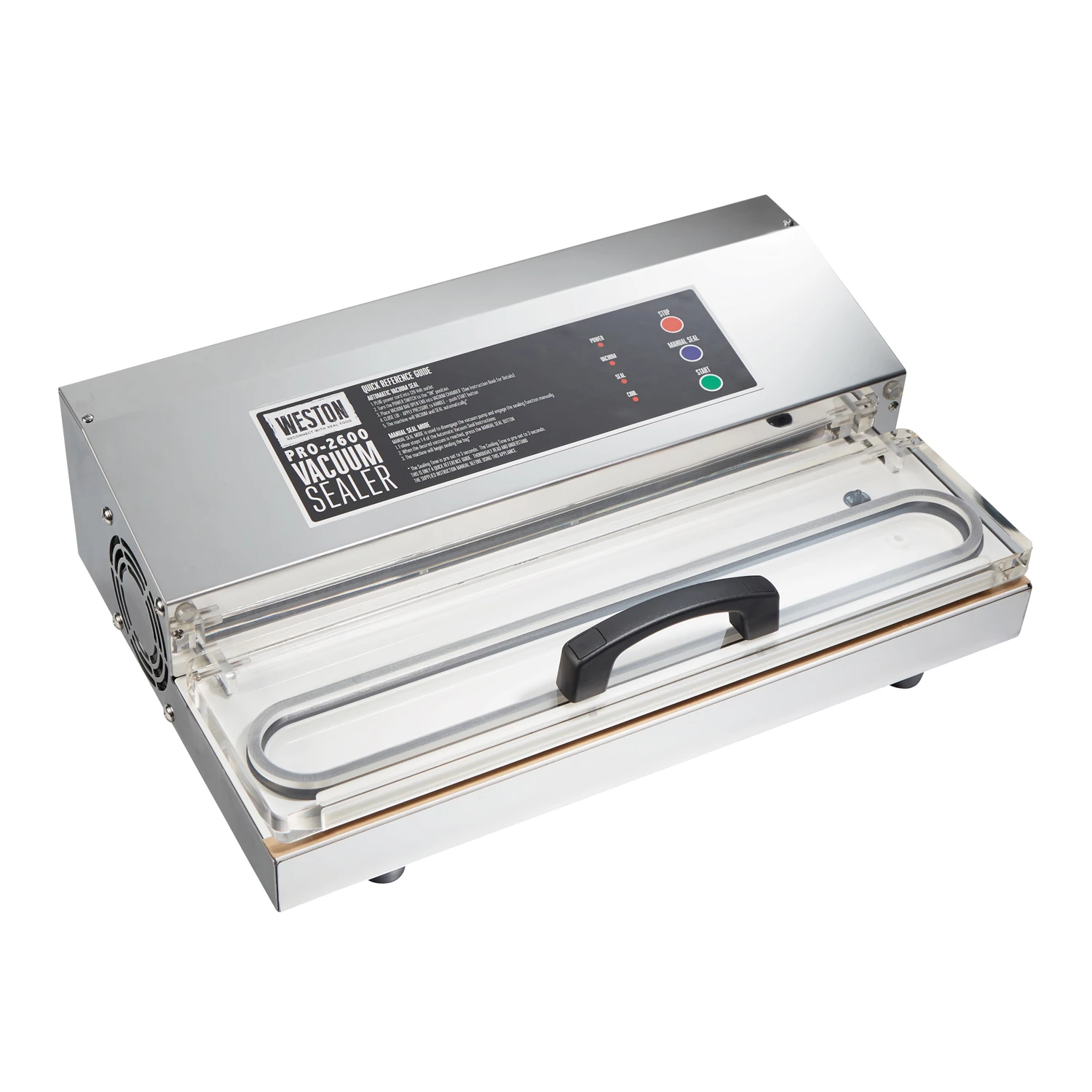
The machine shown on Weston’s exact product page has an external-bag layout: the open edge of the bag sits in the lower vacuum channel, with the food outside the machine. The Weston Pro-series Use & Care document describes Start, Manual Seal and Stop controls. Start begins the automatic evacuation process and seals at the preset point. Manual Seal gives the operator a way to start sealing earlier; Stop halts vacuuming. That is useful when a person is watching a delicate item or trying to keep liquid from advancing toward the port. It is not the same as a separately identified Pulse button, and the manual does not claim that a short press precisely measures remaining air.
The same instructions say to use Manual Seal when vacuum packaging liquids and warn against drawing liquid or powder into the vacuum port. That is an attended external-bag procedure, not a bounded thick-liquid program: the inspected instructions give no viscosity, fill-volume, temperature or maximum-liquid limit. Do not translate “Manual Seal” into a guarantee for soup, sauce or an unattended liquid bag. If your essential need is a clearly bounded liquid process, compare a machine whose exact instructions name the method and limits you require.
Bag routine and operating pace
The Pro-series document calls for a compatible vacuum bag, a flat and uncreased opening, and at least two inches of headspace. Keep the open edge in the lower chamber and close to—but not covering—the port before starting the cycle. The manual recommends mesh- or embossed-lined vacuum bags; ordinary household storage bags are not a substitute. Its instructions discuss forming bags from roll material, but do not establish that the 65-1301-W includes a roll bay or built-in cutter. Likewise, Weston’s qualitative “extra-long” and “extra-wide” description does not supply a verified numerical bag-width limit. Those omissions matter more than the Pro-2600 name if your recipe, storage package or bag stock depends on a particular size.
The manual describes a pre-set three-second seal and three-second cool/release behavior, and asks for at least 20 seconds between cycles with the lid open. It also describes an internal cooling fan and about 20 minutes of cooling after a thermal-overload stop. A fan may help the appliance cool, but it does not cancel the stated interval or create a continuous-duty rating. For a large batch, plan a paced session and allow the machine to cool when instructed. The reviewed manual specifies a grounded 120-volt, 60-hertz supply; neither it nor the exact product page supplies wattage, and electrical input alone would not tell you suction strength or seal quality.
The model-to-manual link deserves a caveat
Weston’s product record and archive identify 65-1301-W directly, and the exact-page image visibly labels the panel “PRO-2600 VACUUM SEALER.” The official 48-page Pro-series Use & Care document supplies the control and operating instructions described here, but its cover says only “Vacuum Sealer”—it does not print 65-1301-W. The documented instructions correspond to the visible controls and bag route, but the inspected materials do not provide a SKU-specific manual cover. Treat that manual-to-model association as a shared Pro-series evidence bridge, not proof that every Pro-branded Weston model has identical controls or limits.
Who should consider it?
The Pro-2600 is worth considering as a reference for someone who already has, or is evaluating, a particular 65-1301-W and values its automatic Start cycle plus an attended Manual Seal option. It can make sense for dry portions in compatible external bags and for carefully monitored liquid packaging only when the operator can follow the manual’s warning and stop before liquid reaches the port. An older offer deserves a hands-on check: verify its model label, lid, chamber seal, seal-bar surface, cord and actual accessories. The original product-page description cannot establish the condition or bundle of a used machine.
It is not a safe fit for a shopper whose essential requirement is a known 12-inch-or-larger bag opening, a built-in cutter, a roll-storage compartment, a dedicated pulse function, a numerical liquid capacity or continuous operation. The official page supplies no width number; the manual sets a pause; and those missing features cannot be marked as present just because the model is called Pro. If you want a different routine, compare exact current Weston models rather than assuming a similar product name means the same controls. In particular, the 65-1601-W’s wet/dry controls and the 65-1641-W’s documented liquid routine are distinct product configurations, not evidence that this Pro-2600 has their programs.
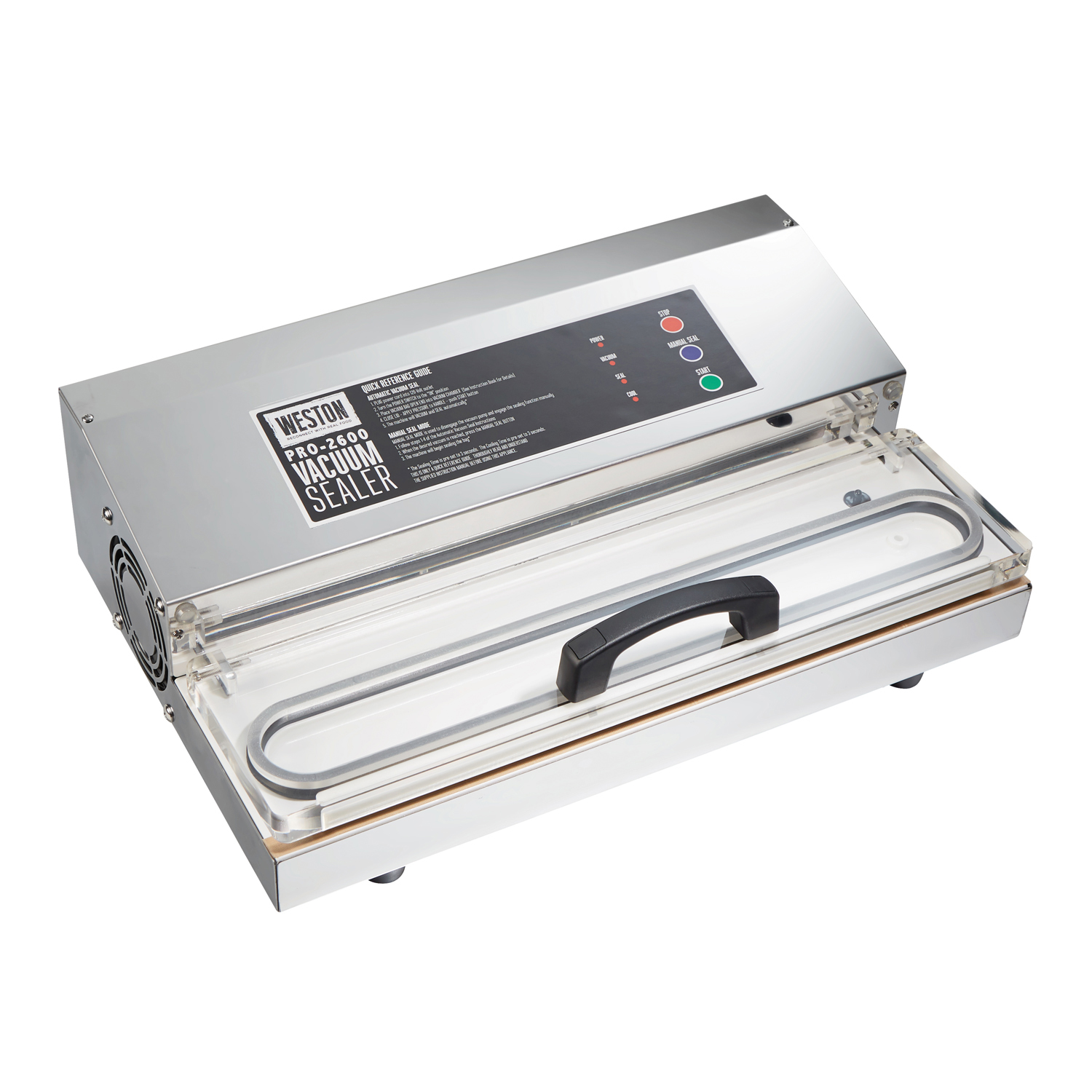
The official 65-1301-W product image is assigned to the exact page and visibly shows the external machine and its Pro-2600 panel; its photography-versus-render method is not disclosed. The image is useful for recognizing the control layout, not for confirming internal condition or a retailer’s package contents. In the finder, choosing earlier=yes is necessary before this archived model can appear. Require a numeric minimum width, a separate Pulse mode or continuous-batch use and the unknown will properly disqualify it; choose an ordinary external-bag/dry-food path and it remains a possible earlier reference.
Sources: Weston’s 65-1301-W product record, vacuum-sealer archive, and Pro-series Use & Care document. The manual cover does not print this model SKU.
Key details at a glance
| Mechanism | external |
|---|---|
| Power and charging | The official Use & Care document specifies a grounded 120 V, 60 Hz supply. The exact Weston page/manual reviewed does not establish an electrical wattage. Input power would not by itself be a suction, speed or seal-strength test. |
| Operating interval | The Pro-series Use & Care instructions require at least 20 seconds between cycles with the lid open and about 20 minutes of cooling after a thermal overload trip. A fan is listed as an internal component, but it does not waive the stated pause or establish continuous duty. |
| Supplies and accessories | Use compatible vacuum-sealer bags; the manual recommends embossed or mesh-lined bags and excludes ordinary household bags. It describes making bags from roll material, but exact sources reviewed do not establish an integrated cutter, roll-storage bay, included canister/accessory kit, numerical bag-width limit, or starter-kit contents. Verify an older offer's label, lid, chamber seals, cord and parts. |
| Care and storage | Unplug, let the appliance cool, and wipe the outside, plastic vacuum chamber and clear lid with a damp cloth or paper towel. Do not immerse, spray into the vent or use abrasive cleansers on the clear lid; avoid damaging the seal-bar tapes and chamber seals. |
Use the exact model’s instructions for operating limits, supplied equipment and version differences.
Sources for this assessment
Find a process that fits your food.
Combine package type, moisture and essential conveniences, then read the operating limits.