
Your needs, this model
Does it fit your priorities?
Does the exact Pro-3500 offer an attended Pulse control in addition to a timed-vacuum mode?
Yes. The model-linked guide names Full Vacuum, Vacuum Time, Pulse and Manual Seal. Pulse lets the operator apply vacuum in presses before sealing; it is not a named liquid program or an automatic pressure sensor.
Explore this need in the finder →What roll width is documented for the built-in holder and cutter?
Weston's model-linked guide says the roll holder accepts bags up to 11 inches wide. It does not state a wider roll limit. The machine's ability to accept every pre-made pouch width is not established by this holder specification.
Explore this need in the finder →Does the documented routine cover prepared moist solids without claiming an unfrozen-liquid mode?
The storage guidance recommends freezing meat and fish for one to two hours so moisture and juices do not interfere with sealing. The inspected guide does not establish a dedicated unfrozen-liquid setting or unbounded broth/sauce process; its canister option requires separately sold canister and hose.
Explore this need in the finder →Weston · Pro-3500 Stainless Steel Vacuum Sealer · exact U.S. model 65-0901-W · current manufacturer reference
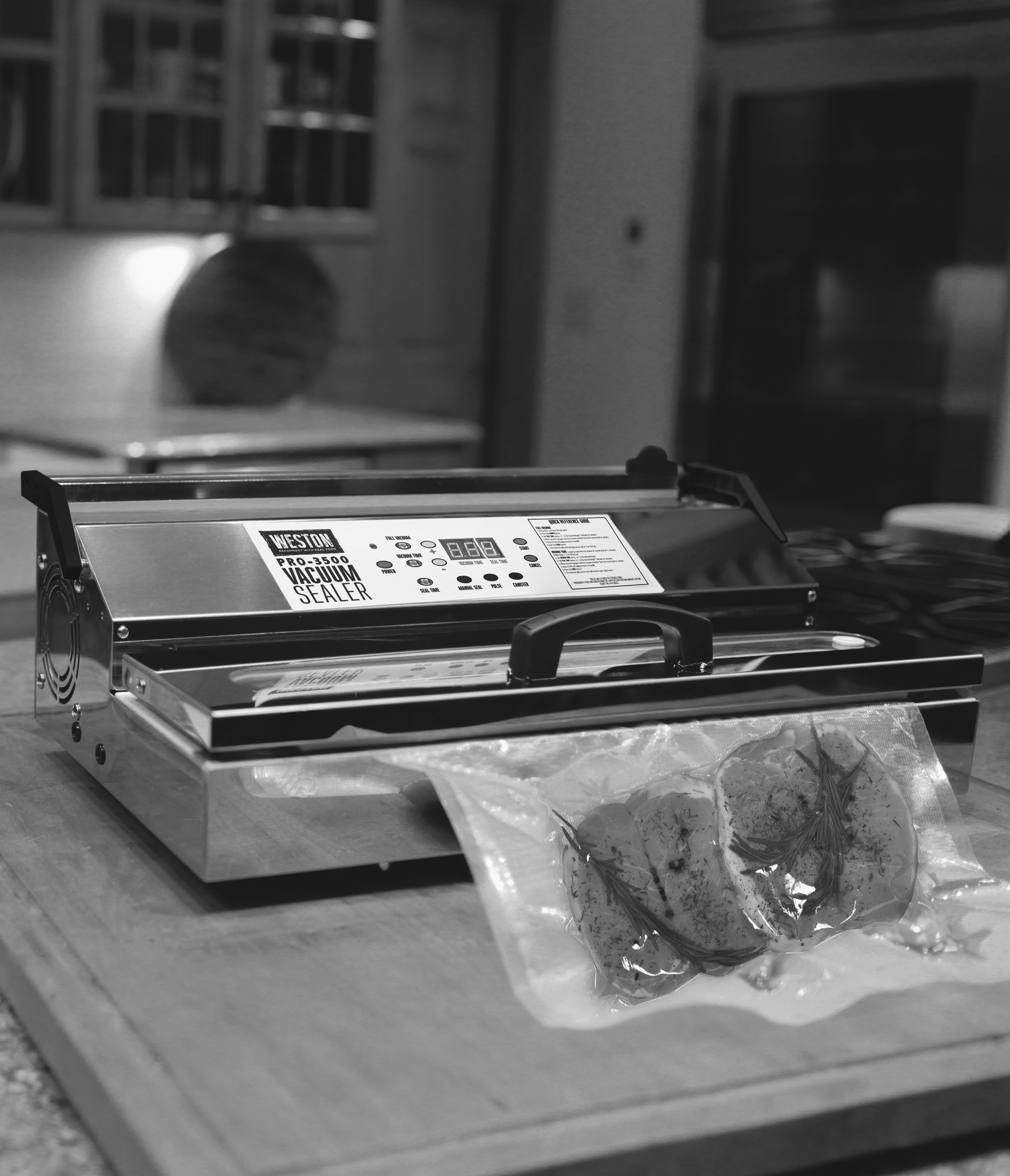
The Weston Pro-3500 65-0901-W is an external-bag sealer for someone who wants more than a one-button cycle: its model-linked Use & Care guide documents Full Vacuum, adjustable vacuum time, Pulse, Manual Seal and Canister controls. It also includes a roll-holder/cutter arrangement whose guide specifies rolls up to 11 inches wide. This is more operator-directed than the Pro-2600, but the model number is not a performance test and continuous-duty or unrestricted-liquid use is not established.
When a Pulse control matters
The Pro-3500 keeps the filled portion of a textured vacuum bag outside the machine while its open end sits across the lower vacuum chamber. Full Vacuum evacuates the bag automatically and then seals it. Vacuum Time lets the operator set a number of seconds for evacuation. Pulse is different: each press engages the pump, so the operator can stop the vacuuming as food changes shape, then use Manual Seal to close the bag. Pulse is useful for fragile items, but it is an attended technique, not an automatic sensor for the ideal vacuum.
Seal Time can also be adjusted. The guide recommends a three-second starting seal for its 3-mil bags and tells owners to test a couple of bags, inspect the seam and adjust in one-second increments if the seam is too weak or melts through. Treat that recommendation as a starting point for the stated bag, not a universal setting for every thickness or brand. Weston’s manual says to use compatible embossed or mesh-lined vacuum bags, not ordinary household storage bags. Bag texture and a clean, flat mouth matter more than the stainless finish.
Roll handling and the 11-inch limit
The model-specific component list names a roll-holder assembly, cutter arms and a sliding cutter. The instructions say that the roll holder accommodates bag rolls up to 11 inches wide. If that is the routine you want, the built-in cutter avoids fetching scissors for each length. But the manual documents an 11-inch roll-holder limit, not a number for every pre-made pouch or a separate seal-bar width specification. A shopper with wider bags should not assume they fit because another Weston Pro model does. The manual’s two-inch minimum headspace and careful placement over the vacuum channel also leave some setup work at each bag.
Food preparation and pace are part of the choice
The guide establishes no dedicated liquid setting or loose-soup routine. Its storage guidance recommends freezing meat and fish for one to two hours before vacuum packing so juices are less likely to interfere with the bag seal. That is a prepared-moist-food approach, not proof that freely flowing broth or sauce can be sealed safely with Pulse. The manual also describes a canister button and accessory port, but says canisters are sold separately; a buyer who needs a supplied canister must check the exact package rather than treating the button as included equipment.
Plan a paced session: The manual’s cooling section says to wait at least 20 seconds between cycles with the lid open, while its bag-seal instructions say to wait at least 30 seconds before sealing another bag. Since those passages differ, use the longer 30-second interval unless Weston clarifies it. If the thermal protector shuts the unit down, the guide says to let it cool for about 20 minutes. Three internal fans do not erase these cautions or demonstrate uninterrupted production capacity.
Counter space, power and lifecycle
The Weston record lists a net weight of 39.1 pounds, so this is not a lightweight handheld appliance to move for every portion. The guide specifies a grounded 120-volt, 60-hertz outlet and a 20-amp fuse. Neither the exact model record nor the inspected manual supplies a verified wattage. Dimensions in the product record are not presented clearly enough to treat as closed-body clearances, so measure the counter and lid-opening area using the physical unit or a reliable exact-model diagram before dedicating storage space.
Weston’s exact U.S. product page identifies the Pro-3500 as 65-0901-W and remains a live manufacturer listing. Its structured record labels Web Availability “RUNOUT”; that is a transition signal, not a promise of present stock or proof of a dated discontinuation. The site therefore treats it as a current manufacturer reference, not as a guaranteed purchasable item. Confirm the seller’s model plate, return policy and package contents before buying. The image available here is from Weston’s Pro-3500 manual cover; Weston cautions that the pictured machine may differ slightly from the unit in the box, so use it to recognize the general layout rather than a precise cosmetic revision.
Who should choose it—and who should compare first?
Consider the 65-0901-W if your usual work is compatible heat-seal bags, you value manual Pulse and timed evacuation, you want an integrated roll holder/cutter, and 11-inch rolls are sufficient. It can also be used for moist solid portions when you follow the manual’s preparation advice. Pass if a dedicated liquid program, supplied canister, exact wider-than-11-inch roll capacity or continuous batches are essential; those conditions are not established here.
For a documented 15-inch bag routine, compare the Weston Pro-3000 65-0401-W rather than assuming this model has the same opening. For a person comparing an older Pro-2600 65-1301-W, note that the Pro-2600 page describes an extra-wide bar without a numeric limit and its reviewed controls do not include a dedicated Pulse button. The Pro-3500 is the clearer choice when manual vacuum timing and an 11-inch roll system are the priority; the Pro-3000 is the better documented alternative when wider bags matter. None of these distinctions makes one model a universal upgrade—choose the exact routine, bag width and cooling pace you can support.
Sources: Weston’s exact 65-0901-W product record and model-linked Pro-3500 Use & Care guide. The guide includes a notice that its pictured product may differ slightly from the unit in the box.
Key details at a glance
| Mechanism | external |
|---|---|
| Power and charging | The exact Weston guide specifies a grounded 120 V, 60 Hz supply and a 20-amp fuse; the exact product record and inspected manual do not provide a verified wattage. Input power alone would not establish vacuum or seal performance. |
| Operating interval | The official guide's cooling section says to wait at least 20 seconds between cycles with the lid open; the bag-seal instructions say at least 30 seconds before sealing another bag. Follow the more conservative 30-second interval unless Weston clarifies the difference. After a thermal-overload stop, the guide says to cool for about 20 minutes. Three internal cooling fans do not establish continuous-duty operation. |
| Supplies and accessories | Use recommended embossed or mesh-lined vacuum bags, not ordinary household bags. The guide documents a roll-holder/cutter arrangement and rolls up to 11 inches wide. It documents a canister button and accessory port, but says the canister and hose are sold separately. Exact box contents beyond the named machine components, pre-made pouch-width limit, body dimensions and wattage are not established. |
| Care and storage | Unplug the machine and let it cool. Wipe the outer surfaces, plastic vacuum chamber and lid with a damp cloth; do not immerse, rinse under a tap or spray directly into the vent. Avoid abrasive cleaners and avoid peeling or damaging seal-bar tape and chamber seals. |
| Chamber vacuum adjustment | timed |
Use the exact model’s instructions for operating limits, supplied equipment and version differences.
Sources for this assessment
Find a process that fits your food.
Combine package type, moisture and essential conveniences, then read the operating limits.