
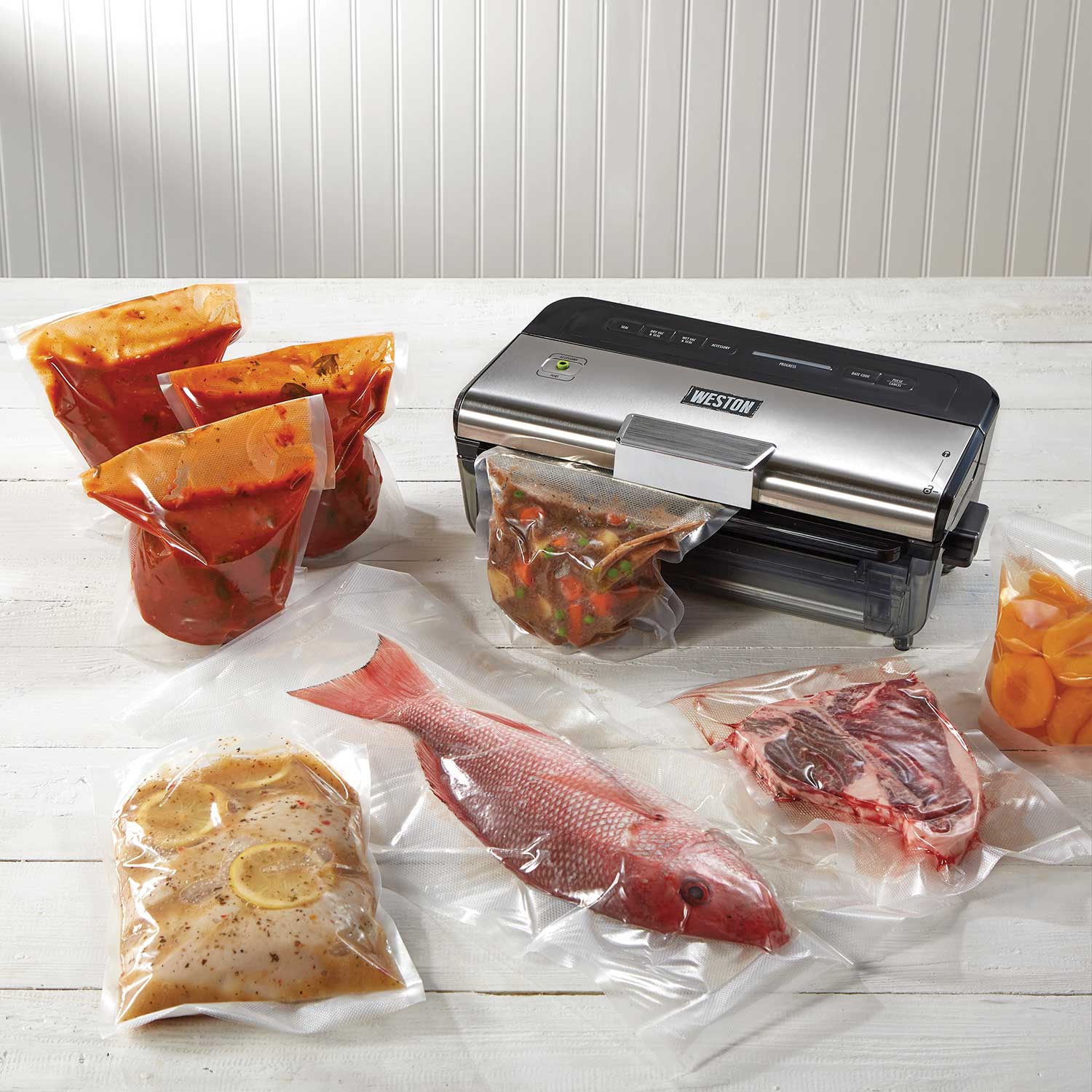
Your needs, this model
Does it fit your priorities?
Can the 65-1601-W run the maker-described wet bag routine for foods such as stew or puree?
Yes, as a separate WET VAC & SEAL process when the bag stays upright, below the roughly half-full MAX LIQUID line, on the raised roll-caddy setup, and the chamber is checked and wiped. No numeric viscosity or volume limit is published.
Explore this need in the finder →Does the exact manual document roll preparation and an integrated cutter on this model?
Yes. The exact 65-1601-W parts diagram and bag-making procedure identify the roll caddy and cutter. They do not give a maximum bag width or a complete starter-kit roll inventory.
Explore this need in the finder →Can I use Pulse for an attended delicate-food bag routine?
Yes. Hold PULSE/CANCEL until the desired air is removed, then use SEAL. This is manual monitoring, not an automatic delicate-food setting.
Explore this need in the finder →Is a canister supplied just because the exact booklet shows an accessory hose?
No. The 65-1601-W booklet says compatible canisters and zipper bags are sold separately; the hose/port alone does not meet a supplied-canister need.
Explore this need in the finder →Can I demand a no-pause continuous bagging session from the 65-1601-W?
No. Its booklet calls for at least 20 seconds between operations and gives 30 seconds between wet cycles. Continuous-batch duty is not established.
Explore this need in the finder →Does the exact record confirm a 12-inch bag-width capacity?
No. A maximum bag width is not stated in the exact product record or booklet, so the unknown width must not pass a 12-inch minimum.
Explore this need in the finder →Weston · Wet & Dry Vacuum Sealer · exact U.S. model 65-1601-W / VC04 · earlier model
The Weston 65-1601-W is an earlier corded external-bag sealer, preserved here for buyers comparing a specific used or leftover offer and for owners identifying the exact unit they have. Weston lists the model in its vacuum-sealer archive; its product record identifies SKU 65-1601-W and labels web availability “RUNOUT.” That is not a current-stock promise. The exact 840351200 Use & Care booklet independently prints 65-1601-W, type VC04, and 120 V / 60 Hz / 170 W. This is a distinct SKU from the currently referenced 65-1641-W, even though both have wet-and-dry labeling. Do not transfer one model’s package list or seller condition to the other.
A real wet cycle, but a guided bag routine
The 65-1601-W’s useful distinction is a separate WET VAC & SEAL control alongside DRY VAC & SEAL. The manufacturer describes liquids such as stews and fruit purees; the booklet says to use the roll caddy when sealing liquids or wet foods. For that procedure the machine sits on top of the caddy to elevate the bag, and the filled bag is held upright so liquid remains below the MAX LIQUID line, which the guide describes as about half full. It also expects the wet cycle to run longer, says some liquid may collect in the vacuum chamber, and advises wiping the chamber between bags. The troubleshooting section distinguishes a 30-second wait between wet cycles from 20 seconds between dry cycles.
Those directions are more useful than a generic “moist” label, but they are not a quantified viscosity table. The exact page gives examples rather than a maximum volume or sauce-thickness limit. An external sealer draws from a bag whose open edge sits in the machine’s channel while the filled part stays outside, so bag posture and clean, flat material matter. If your portion cannot stand upright under the MAX line, or you need an approved thick-liquid limit stated in numbers, this manual does not settle that question. A chamber model has a different package geometry; its own internal dimensions and instructions need checking.
Roll preparation and control without assuming box contents
The exact product page describes two-roll storage and a starter kit. The 65-1601-W booklet depicts a roll caddy, roll cutter and roll-cutter bar, and its procedure explains cutting heat-seal stock to the item’s length plus extra sealing material. It requires heat-seal vacuum bags with at least one textured side for airflow and warns against ordinary household plastic bags. The exact materials reviewed do not establish a maximum bag width, finished pouch length, body dimensions, or a precise inventory of the starter-kit rolls and bags. Weston’s manual itself notes that bags or rolls are included with certain models or purchased separately. If an exact width or supplied roll size matters, verify the package label or contents rather than borrowing the 8- and 11-inch roll list from the separate 65-1641-W booklet.
There is also a PULSE/CANCEL button for attended manual vacuuming of delicate foods or nonfood items. The booklet directs the operator to hold Pulse until the desired amount of air is removed, then use SEAL; it is a hands-on control, not another automatic food program. DATE CODE can stamp a month and day before either dry or wet cycle. An accessory port and hose are shown, but the booklet says compatible canisters and zipper bags are sold separately. An accessory connection alone is not a supplied canister kit.
Older equipment needs a deliberate pace
This unit is not documented for uninterrupted commercial batches. The 20-second dry and 30-second wet pauses are practical boundaries even if the controls appear ready for another cycle sooner. The 170-watt rating is electrical input, not a measured vacuum level, speed, seal strength or bags-per-hour figure. For a used model, pay attention to the chamber seals, the roll caddy and cutter, the lid lock, the hot sealing strip and the state of the included hose. If one of those parts is missing, the manual does not prove that an exact replacement will be available today.
After use, unplug the machine and let it cool completely before wiping the exterior and chamber. Do not immerse it; leave the lid unlocked in storage so its seals are not held compressed. The exact manual gives a five-year limited warranty for products purchased and used in the U.S. and Canada, but that text is not a guarantee for a secondhand purchase; check the original receipt and printed conditions. Vacuum packaging also does not make perishable food shelf-stable. Follow FSIS guidance for refrigeration and freezing.
Who should keep this model on the list?
Keep the 65-1601-W as a reference if a particular offer includes the matching VC04 appliance and you want both documented dry-bag and wet-bag workflows, caddy-based roll handling, Pulse/Cancel and date coding. The assessment changes when your answers change: a thicker-liquid bag routine, roll cutter or Pulse requirement can fit the documented setup, but a required supplied canister, continuous batch, confirmed 12-inch width or precise countertop fit cannot be assumed. Because Weston places the model in its archive and marks its product record RUNOUT, it is not a default-current recommendation; the finder includes it only when earlier configurations are explicitly requested. The exact 65-1641-W review is the separate comparison point for a wet/dry Weston, and the Compact 65-2061-W is a separate dry/prepared-moist option without a documented direct-liquid program. Neither alternative erases the need to verify an older unit’s condition and exact box contents.
Sources: Weston’s exact 65-1601-W product record, the Weston vacuum-sealer archive, and the exact model’s VC04 Use & Care booklet (English operating section and 65-1601-W rating appendix). The manual does not specify a maximum bag width, body dimensions, liquid viscosity or a complete starter-kit contents list.
Key details at a glance
| Mechanism | external |
|---|---|
| Power and charging | The exact model appendix lists 65-1601-W, VC04, 120 V, 60 Hz and 170 W. This is electrical input, not a suction, speed or sealing-strength measurement. |
| Operating interval | The exact booklet says to leave at least 20 seconds between operations; its trouble-shooting section specifies 20 seconds after dry cycles and 30 seconds after WET VAC & SEAL. No continuous-duty or bags-per-hour claim is established. |
| Supplies and accessories | The exact Weston page says the package includes a starter kit and two-roll storage but does not itemize the kit. The exact manual identifies textured heat-seal bags/rolls, a roll caddy/cutter, date coder and accessory hose; compatible canisters and zipper bags are sold separately. Do not transfer the 65-1641-W booklet’s specific included roll sizes or bags to this SKU. |
| Care and storage | Unplug and let the unit cool completely before wiping the exterior and vacuum chamber with a damp cloth or paper towel. Do not immerse it. Wipe any liquid from the chamber between wet cycles as needed, and store with the lid unlocked to avoid prolonged compression of the chamber seals. |
Use the exact model’s instructions for operating limits, supplied equipment and version differences.
Sources for this assessment
- Weston Wet & Dry Vacuum Sealer exact product record, SKU 65-1601-W
- Weston vacuum-sealer product archive
- Weston Vacuum Sealer (65-1601-W) VC04 Use & Care, exact model rating appendix
- Weston official product-page original for SKU 65-1601-W
- USDA Food Safety and Inspection Service: Can I keep meat in vacuum packages at room temperature?
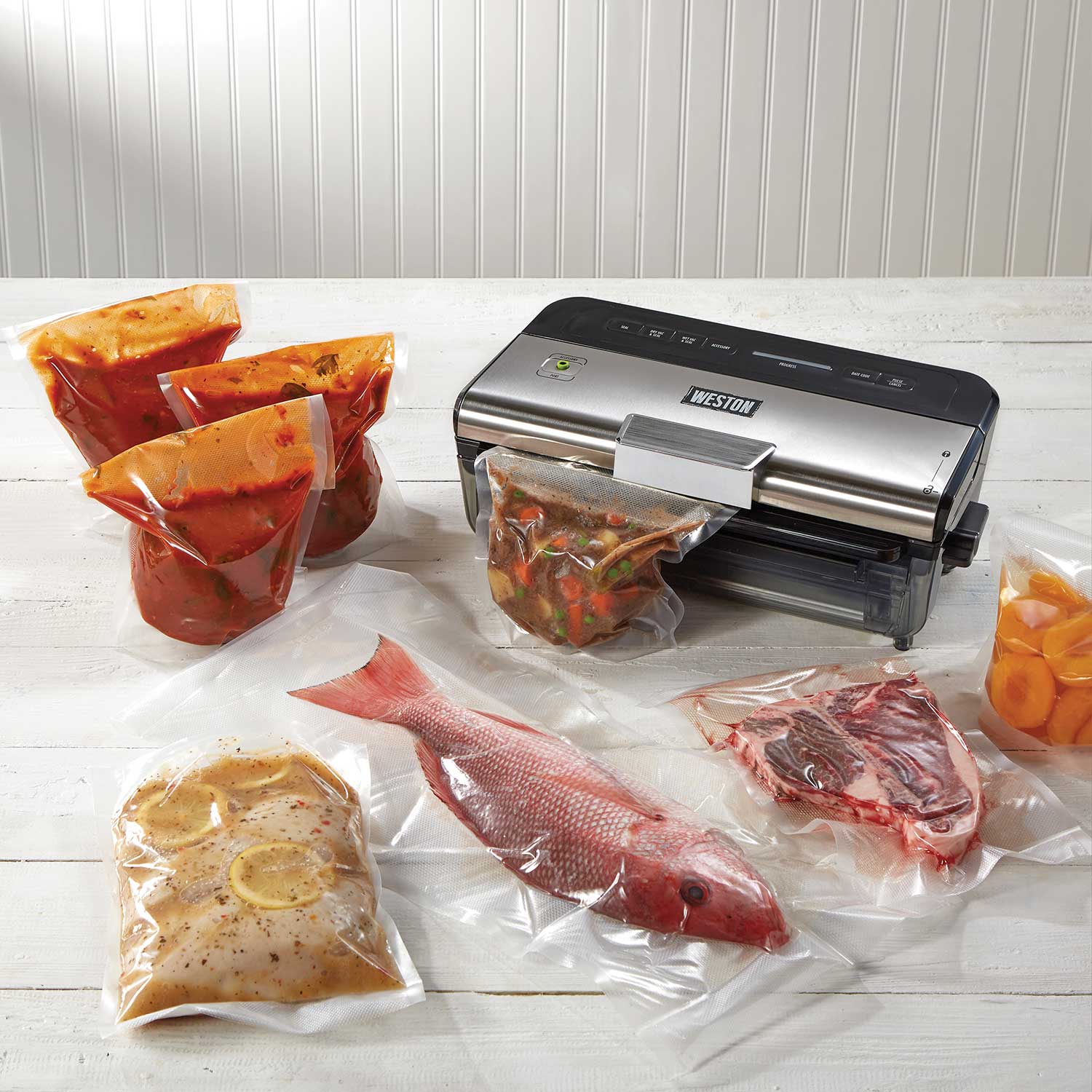
Find a process that fits your food.
Combine package type, moisture and essential conveniences, then read the operating limits.