
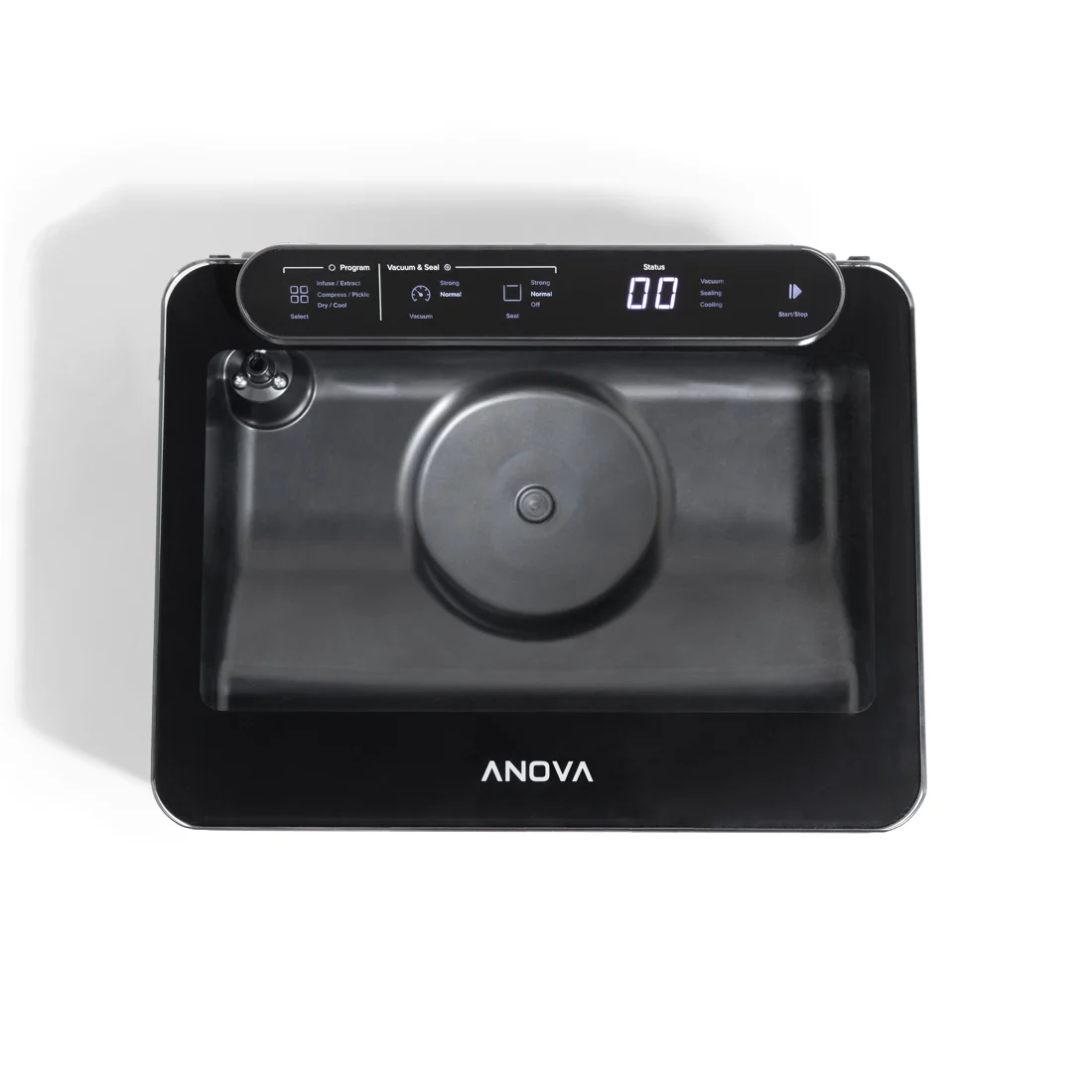
Your needs, this model
Does it fit your priorities?
Can I require a chamber setup for cooled, unfrozen liquid in heat-seal pouches?
Yes. The exact US product supports liquid foods. The filled bag must fit inside the chamber and follow the guide's placement and temperature instructions.
Explore this need in the finder →Can I require a closed body no wider than 14 inches?
Yes. The official labeled body width is 13.6 inches. That does not account for the open lid or the space needed to work.
Explore this need in the finder →Does an infusion program qualify as an included Mason-jar sealing system?
No. The open-container programs do not use the sealing bar or establish a jar-lid vacuum attachment. No included Mason-jar route is documented.
Explore this need in the finder →The Anova Precision Chamber Vacuum Sealer is the meaningful change of mechanism in this lineup. The entire filled pouch sits inside a rigid chamber while air is removed from the surrounding space. That makes it relevant to liquid portions and to pressure-based food preparation. The tradeoff is a fixed interior volume: a portion must fit the chamber properly rather than simply extending across the counter in front of an external sealer.
Size the filled portion, not just the empty bag
The current maker specification gives an internal chamber approximately 12 inches wide, 8.6 inches deep and 3 inches high, with an 11.8-inch sealing bar. These are different measurements. The bar length is not a guarantee that every bag of that nominal width will fit once filled, and the chamber's height limits bulky food as well as rigid containers.
The manual positions the food over the circle in the middle of the chamber. Straighten the open edge over the sealing bar, lift the holder, secure the edge beneath it and close the lid. Plan the filled pouch so it can lie in that arrangement without forcing the food or wrinkling the sealing edge. Keep long, irregular items in mind before deciding that a chamber is automatically an upgrade for every portion.
A different approach to cool liquids
The manufacturer explicitly documents liquid sealing, including soup and marinated food. The chamber changes the pressure around the whole pouch, instead of pulling only through an opening at the edge of an externally supported bag. That is the reason to consider it when unfrozen liquid is central to the job.
You still need suitable food-packaging material, an appropriate fill and a clean sealing area. Liquid can expand or bubble as pressure changes. Stay with the procedure and do not treat the glass lid as a promise that spills cannot happen. A chamber routine is also distinct from hot filling or shelf-stable preservation; the sealed food still needs its appropriate handling and storage.
Standard sealing and food-preparation programs differ
The normal Vacuum & Seal controls let you choose vacuum strength and seal behavior, including turning the seal stage off. Holding the relevant control opens time editing. During operation you can end the current stage using the indicated control, and the Start/Stop function can cancel a cycle. Wait for the cycle to finish before trying to open the lid.
The three preparation programs are Infuse/Extract, Compress/Pickle and Dry/Cool. Crucially, the manual says the sealing bar is not used in these program modes. Running a pickling program is therefore not the same action as creating a sealed storage pouch. Treat the programs as different preparation tools rather than extra automatic bag-sealing settings.
Open containers have their own limits
For infusion and pickling, the manual describes an open jar or container no taller than its stated limit of 2.8 inches, also printed as 75 mm. Those two figures are not an exact conversion; use the more restrictive height and confirm physical clearance. The guide also limits filling to halfway to leave room for bubbling and expansion.
That route does not establish an included Mason-jar lid-sealing kit. An open container used during a preparation program and a jar with an evacuated, sealed lid solve different tasks. Someone who wants dry goods sealed under regular or wide-mouth lids should examine the dedicated NESCO Mason Jar Sealer and its own restrictions.
Give the machine room to open and stay clean
The maker lists a body approximately 13.6 inches wide, 11.2 inches deep and 8.9 inches high. Allow extra vertical access for the glass lid, plus room to load and remove the pouch. The closed dimensions do not establish a cabinet installation or a convenient working clearance.
Unplug before cleaning. The manual prescribes wiping the glass and interior with suitable mild cleaning materials, drying thoroughly and keeping the removable door seal clean and properly refitted. The pump is described as a maintenance-free dry pump, but that does not mean the chamber and door gasket maintain themselves. No personal pump-life or sealing-speed test is claimed here.
Choose the mechanism for the task
The chamber model is a sensible candidate for repeat liquid portions and for cooks who will use its open-container preparation programs. An Anova Pro external sealer can be more convenient for long bags and roll-based portioning, while the basic Precision model keeps the interface simple. Those external models do not inherit this chamber's liquid capability.
Start with cool unfrozen liquid in a heat-sealed chamber pouch. Then check the actual filled portion against the chamber, rather than choosing from the sealing-bar number alone.
Key details at a glance
| Mechanism | chamber |
|---|---|
| Power and charging | US ANCV01-US00 product configuration: 120 V AC, 60 Hz, 280 W. Do not substitute the separate 230 V market option. |
| Operating interval | Adjustable bag vacuum/seal controls and preparation programs are documented. Back-to-back Dry/Cool preparation is not proof of continuous bag heat-sealing duty. |
| Supplies and accessories | Choose compatible chamber pouches that fit the chamber and sealing path. The 11.8-inch sealing bar is not automatically a certified maximum pouch width. |
| Care and storage | Wipe the glass and chamber with a warm damp cloth and mild soap, then dry. Clean, dry and refit the removable lid seal as instructed. Do not immerse. |
| Confirmed closed body width | 13.6 in |
Use the exact model’s instructions for operating limits, supplied equipment and version differences.
Sources for this assessment
Find a process that fits your food.
Combine package type, moisture and essential conveniences, then read the operating limits.