
Your needs, this model
Does it fit your priorities?
Can I require manual pulse for dry food in heat-seal bags?
Yes. The exact guide documents manual Pulse followed by Seal, alongside the normal external bag cycle.
Explore this need in the finder →Can I require continuous back-to-back batch sealing?
That duty is not established. Cooling troubleshooting is not a continuous-use rating, so an essential batch requirement rejects this configuration.
Explore this need in the finder →Can I vacuum bag cool, unfrozen liquid?
No approved route is established. The guide expressly says to avoid liquids in the bag.
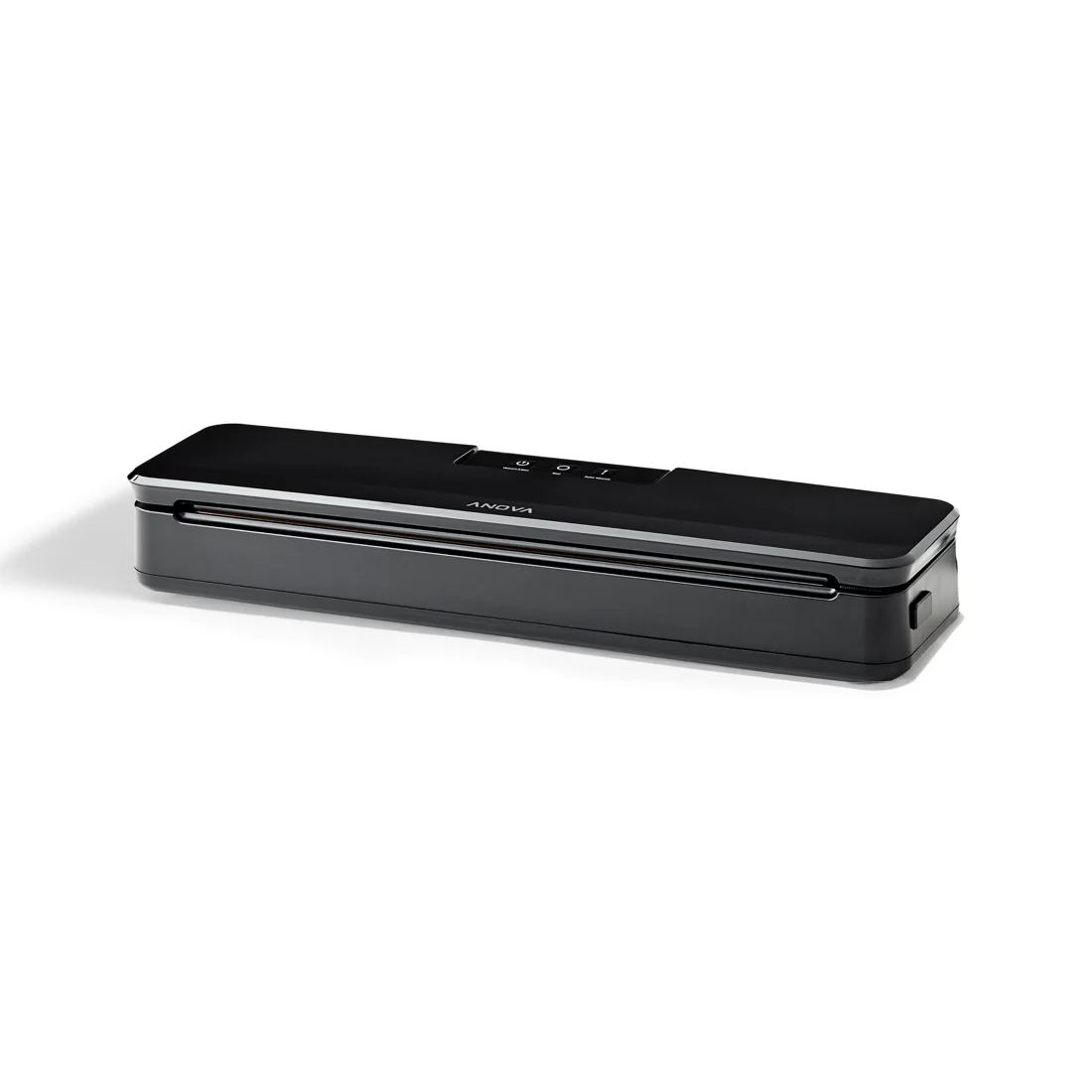
Explore this need in the finder →The Anova Precision Vacuum Sealer is a simple external bag machine for a cook who wants three direct controls rather than storage compartments and a long row of settings. Automatic Vacuum & Seal handles the usual job, Seal closes suitable material without evacuating it, and Pulse provides manual control before sealing. Choose the US-plug ANVS01-US00 configuration for this assessment. The maker also lists different electrical-market variants under the same product name.
A direct routine for ordinary portions
The illustrated instructions show the bag opening resting inside the narrow channel beneath the lid, with the filled portion outside. Close and latch both ends before starting. When the cycle finishes, use the release buttons to lift the cover. A clean, flat mouth matters: a wrinkle or food residue can make an otherwise suitable bag difficult to evacuate or seal.
This approach works best when the portion is already organized and supported on the work surface. Leave enough spare material above the food to reach the channel comfortably. Pulling a short bag tightly toward the heating strip can make the whole process less convenient than it needs to be. The machine's simple interface does not remove the preparation and inspection steps.
Pulse is the reason to look beyond automatic operation
Pulse lets the operator control how much vacuum to apply, then select Seal at the desired point. It is useful when you want to watch the bag around a delicate item instead of allowing the full automatic sequence to decide when to seal. It is still an operator-controlled process, with no sensor that recognizes a fragile portion or guarantees its texture.
There is no dedicated Moist control established in this basic model's three-button instructions. That does not make every food task impossible, but it does distinguish this machine from the Precision Vacuum Sealer Pro, which has separately documented dry/moist settings and a different set of conveniences. Select those controls because you will use them, rather than treating the Pro name as an unexplained quality score.
Keep free liquid out of the bag-vacuum routine
The linked illustrated guide explicitly warns against using liquid in the bag. Seal-only closure and vacuum packing are different actions: a button that closes a suitable bag does not establish that the pump can evacuate an unfrozen soup portion. Likewise, a bag that looks dry around the edge can still carry liquid toward the channel as it collapses.
If ready-to-pour liquid portions are the main task, compare the Precision Chamber Vacuum Sealer. It encloses the filled pouch and uses a different pressure arrangement. Do not transfer that capability to this basic model. For wet or irregular portions, follow the exact preparation guidance for the machine you choose and keep the sealing surface free of liquid, grease and crumbs.
Its size and specifications need practical context
The maker lists body dimensions of 16.73 by 4.80 by 3.14 inches and a mass of 2.3 pounds. That is useful when deciding where to store it, but a closed body measurement is not the whole working footprint. You also need room in front for the bag, access to both lid releases and clearance to open the cover.
The listed extraction rate and vacuum-pressure figure are manufacturer specifications, not our measured results or a reliable shortcut to ranking seal quality against other machines. We have not tested its speed, sound or long-term reliability. A user who wants a documented continuous-batch claim should examine the Pro's specific claim and instructions; no such capability is established here merely because the basic machine has an automatic cycle.
Cleaning and troubleshooting are part of ownership
Unplug the machine before cleaning and keep the electrical appliance out of water. The diagrams show wiping the vacuum and sealing area. Inspect the gasket seating and the bag mouth when the machine fails to evacuate properly. The troubleshooting section distinguishes a misplaced opening, a damaged gasket and a leaking bag rather than assuming every failed attempt means the motor is defective.
If the heating element becomes too hot and melts the bag, the instructions call for allowing it to cool before trying again. That recovery advice is not a quantified promise about how many consecutive seals it will handle. Check that the food is suitable for the intended storage method and continue appropriate refrigeration or freezing; vacuum packaging is not a replacement for those requirements.
Who should choose the basic model?
Consider it when the attraction is a lightweight, straightforward machine for compatible open-end vacuum bags and manually controlled sealing. Compare the NESCO VS-C1 for another simple pulse-controlled approach, paying attention to its explicit work-cycle restriction. Choose the Anova Pro when its roll storage, cutter, hose port and separate food settings solve additional tasks you actually have.
Start with dry-food heat-seal bags and manual pulse control. That captures the basic model's documented strengths without quietly adding chamber-liquid capability or an unverified batch rating.
Key details at a glance
| Mechanism | external |
|---|---|
| Power and charging | The exact ANVS01-US00 variant is US Plug, 120 V. A US input wattage is not established here. |
| Operating interval | The guide addresses overheating and cooling but does not establish a quantified normal continuous-sealing duty. Continuous-batch capability remains unknown. |
| Supplies and accessories | Use compatible vacuum-sealer bag material. The diagrammed starter bags do not independently establish an exact current US package quantity. |
| Care and storage | Unplug, wipe and dry the bag path; do not immerse the appliance. Inspect clean gaskets and the bag mouth before treating a leak as a pump fault. |
Use the exact model’s instructions for operating limits, supplied equipment and version differences.
Sources for this assessment
Find a process that fits your food.
Combine package type, moisture and essential conveniences, then read the operating limits.