
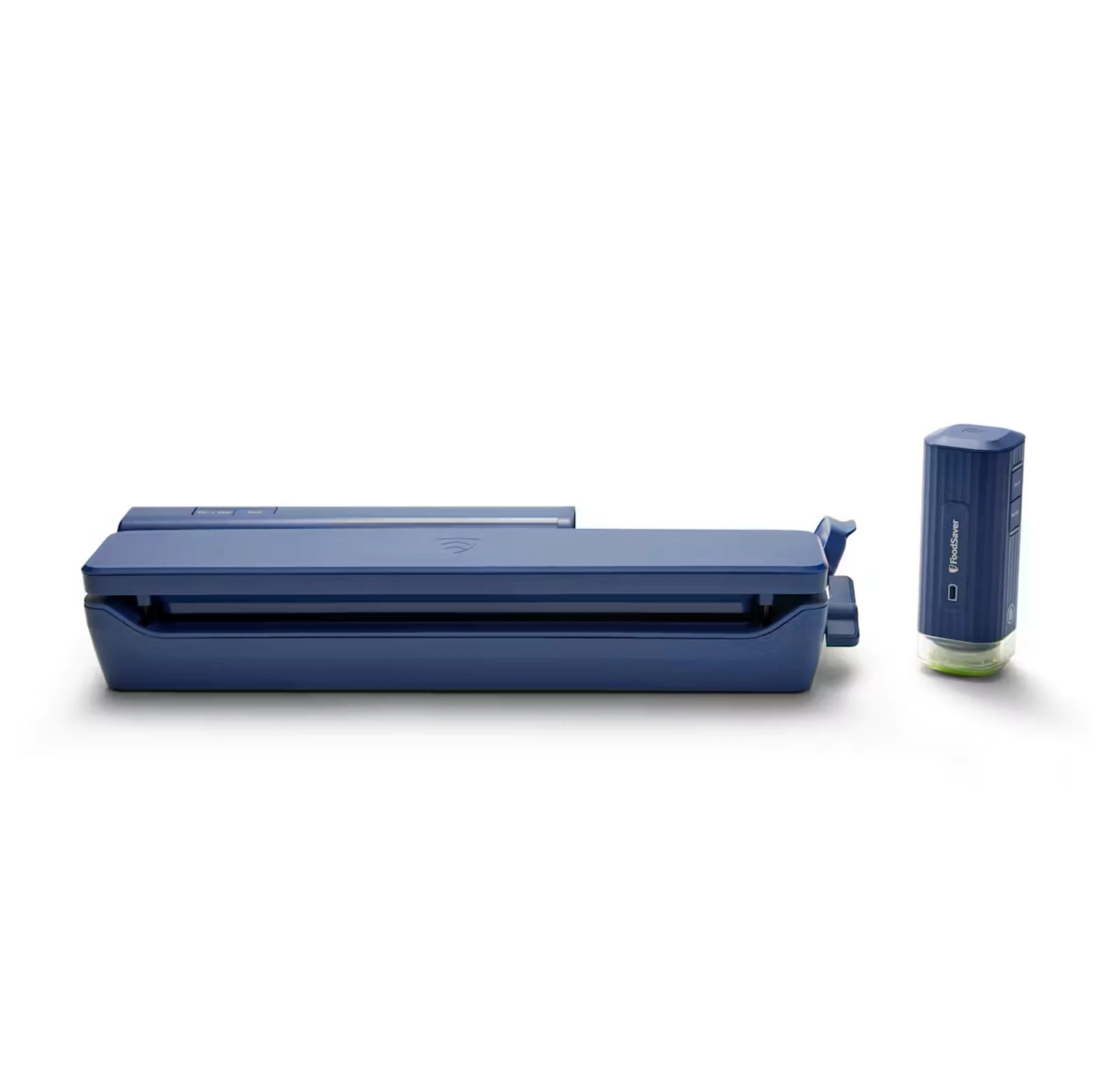
Your needs, this model
Does it fit your priorities?
Can I use its countertop base to vacuum and heat-seal compatible open-end bags?
Yes. Use the mains-powered base with its handheld correctly docked and follow the bag-loading and latch procedure.
Explore this need in the finder →Can I require cordless pumping for compatible valve bags?
Yes. Remove the charged handheld pump and use it over the valve of a correctly closed compatible bag.
Explore this need in the finder →Can I require cordless vacuuming and heat sealing of open-end bags in the same routine?
No. Only the removable valve pump is battery powered; the countertop vacuum-and-heat-seal routine needs mains power and its docked handheld.
Explore this need in the finder →The FoodSaver Handheld+ combines two routines that are often separate purchases: heat-sealing open-end bags on a countertop base, and removing a rechargeable handheld pump to evacuate compatible valve bags. The current black and blue offerings belong to the MS2000 manual family; FoodSaver identifies their retail models as MS2010 and MS2030 respectively. The system is worth considering when a household alternates between freezer portions and food opened several times during the week. It is not a cordless heat sealer, and the removable pump must be properly docked for the countertop vacuum-and-seal routine.
Two working positions, two kinds of packaging
For an open-end FoodSaver bag, the base uses its sealing strip and vacuum channel. A finished pouch can be labeled and put into the storage conditions appropriate for its contents. For a zipper or reusable valve bag, the handheld comes out of its dock and presses over the valve. Having both routes available is useful when you do not want to cut a freezer-style pouch every time you reach for a small portion.
The handheld has its own battery, but the tabletop appliance still plugs into an outlet. If your requirement is heat-sealing bags away from mains power, this system does not meet it. If your requirement is carrying the pump to a correctly closed valve bag elsewhere on a dry indoor work surface, the removable component is the part that addresses that need.
The dock is part of the operating sequence
Install the handheld in the orientation shown in the manual and press it fully into position. A loose or missing handheld is an operating issue for the combined machine, not simply a missed charging opportunity. This matters if different people share the kitchen: returning the pump to the base should be part of finishing a job, so the next person can use the complete appliance.
The base's Open, Operate and Store latch positions serve different purposes. Operate closes the machine for a cycle; Store avoids leaving the sealing gaskets under prolonged compression. That is a useful distinction for someone who keeps the unit in a cupboard between sessions. Packing it away with the handle in the same position used for sealing can compromise the next setup.
Bag making still involves scissors
The MS2000 instructions describe cutting roll material with scissors, leaving room for the contents and an additional three inches before making the first end seal. Do not choose this model expecting the integrated roll storage and cutter of the NESCO VS-12P. An eight-piece starter-kit title also does not mean that every compatible jar accessory or marinating container is supplied; check the actual package list for the retailer's offer.
The Seal button can end vacuuming early and begin sealing a delicate bag. That gives a useful intervention when a portion starts compressing, but it is not a separately documented Pulse mode. Buyers who specifically want repeated, dedicated manual vacuum pulses should compare machines that provide that control rather than assuming every stop or seal button behaves the same way.
Wet food requires preparation, not wishful settings
The manual's liquid-bag method begins with freezing the liquid solid. For moist proteins, it describes preparation that limits juice reaching the seal. Those are meaningful workflow costs: a batch of soup requires freezer space and advance time before it becomes suitable for the standard bag routine. The removable drip tray is for accidental collection and cleaning, not permission to draw a pouch of unfrozen broth through the vacuum channel.
Compatible Preserve & Marinate Containers have their own handheld procedure. The marinating cycle alternates vacuum and release rather than acting as a manual pulse control for a heat-sealed bag. Containers and jar attachments can make the system more useful, but their availability should not be confused with their inclusion. If the primary job is packaging cooled liquids directly in pouches, compare a chamber machine such as the Avid Armor USV20 and check its loaded pouch limits.
Cleaning and pacing determine everyday convenience
Allow the prescribed 20-second pause between seals. The troubleshooting section describes a longer cooling stop if heavy use overheats the appliance. For occasional portions, that pause can fit naturally around labeling or preparing the next bag; for a long uninterrupted production session, it is a reason to choose equipment with a documented batch capability.
Empty the base's removable drip tray and the handheld's separate reservoir after use. The tray can go on the dishwasher's top rack under the manual's instructions; the handheld reservoir is hand-washed and air-dried. Check and clean the gaskets before storing the dry appliance in Store position. These are two collection areas to maintain, even though the system occupies one home on the counter.
Choose the MS2000 when both packaging routines will earn their place and the handheld will reliably return to its dock. The Mini FS3100 is simpler for a valve-bag-only kitchen; an external machine with an onboard cutter is more convenient when most portions begin with rolls. The MS2000's advantage is the combination of a removable battery pump and a household heat-sealing base, provided those two distinct operating modes match your actual routine.
Key details at a glance
| Mechanism | hybrid |
|---|---|
| Power and charging | Countertop heat sealing requires an electrical outlet and the handheld docked in the base. Only the removable handheld vacuum pump operates from its rechargeable battery. |
| Operating interval | Allow 20 seconds between seals. Heavy-use overheating requires a longer cooling stop; this is household spaced-cycle equipment. |
| Supplies and accessories | The current US catalogue calls this an 8-piece starter kit. Exact consumable counts and optional vessel inclusion are not established by the read model manual, so no supplied-canister or jar plan is assumed. Compatible valve bags use the included removable pump; rolls are cut with scissors. |
| Care and storage | Unplug; clean removable gaskets and drip tray and dry fully. The tray may use the dishwasher's top rack; hand-wash and air-dry the handheld reservoir. Store with latch in Store position. |
Use the exact model’s instructions for operating limits, supplied equipment and version differences.
Sources for this assessment
Find a process that fits your food.
Combine package type, moisture and essential conveniences, then read the operating limits.