
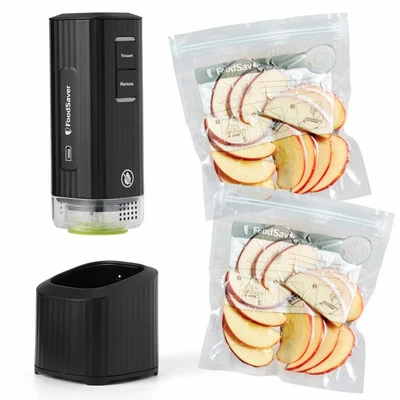
Your needs, this model
Does it fit your priorities?
Can I require a rechargeable pump for compatible valve bags?
Yes. The Mini's battery-powered pump works over the valve of the specified FoodSaver zipper bags; the included dock is used for charging.
Explore this need in the finder →Can it vacuum and heat-seal open-end bags from rolls?
No. The exact manual excludes ordinary FoodSaver bags and rolls; this pump needs the appropriate valve or separately purchased accessory.
Explore this need in the finder →Does this starter package supply a canister for reusable-container sealing?
No. The black 2217128 package lists two quart zipper bags and a dock; a compatible canister is a separate purchase.
Explore this need in the finder →The FoodSaver Mini FS3100 suits a kitchen where bags are opened and resealed repeatedly: a block of hard cheese, a few remaining portions, or dry ingredients used a little at a time. Its rechargeable pump works over a vacuum valve. It does not make a bag from a roll or heat-seal an open edge, so the modest size comes with a clear packaging commitment. This review covers the black Mini package identified by FoodSaver as 2217128, with a charging dock and two quart zipper bags.
Choose the bag system before the small appliance
A valve bag can be opened through its zipper without cutting away another section of material. That is appealing for food you return to several times, and it avoids finding scissors each time you want one portion. The tradeoff is that the bag must have the right valve and a completely closed zipper. Ordinary sandwich bags and FoodSaver's open-end heat-sealing rolls do not become compatible simply because the pump can remove air.
For a first purchase, the two supplied quart bags provide a small starting point. They are not an assortment of containers, jar attachments and bottle stoppers. Decide whether quart bags suit your portions and check the intended storage use on replacement packaging. FoodSaver's current Mini instructions contain conflicting freezer guidance for zipper bags: the bag-use section limits them to pantry and refrigerator use, while later preparation examples describe freezing. Follow the labeling supplied with the actual bags and obtain clarification before using them for a freezer or heated-water routine.
Automatic vacuuming still needs careful placement
Close the zipper along its full length, lay the bag flat with the valve facing upward, and hold the Mini over that valve while its automatic cycle runs. Keep food away from the valve. This is a useful arrangement for a small task at a clear work surface; it is less convenient when a bulky portion leaves the valve tilted or covered.
The machine's automatic stop reduces the number of controls to manage. It does not provide the dedicated manual Pulse control available on the NESCO VS-C1. If preserving the shape of a delicate item is important, consider an appropriate rigid container rather than expecting an automatic bag cycle to judge how much compression that particular food can tolerate.
Marinating is a separate container task
The second button runs a programmed vacuum-and-release sequence for compatible FoodSaver Marinate Containers. It is relevant if you regularly prepare a small portion ahead of cooking and already have, or plan to buy, the appropriate vessel. It adds little value to a buyer whose entire routine is sealing dry snacks in the supplied bags.
Removing the clear reservoir exposes the accessory connection for documented jar and bottle attachments. Those extra purchases expand the system, but they also create separate pieces to store and clean. For a jar-only dry-goods routine, the NESCO VS-MJ-2N1 is a more focused comparison. Vacuum sealing still does not replace canning or the refrigeration required by perishable food.
Plan for charging and short pauses
The dock needs a dry place near an outlet even though the pump can operate away from it. FoodSaver advertises up to 35 quart bags per charge; treat that as a manufacturer limit under its conditions, not a guaranteed session size for every container. A large vessel and repeated marinating cycles are different jobs from evacuating a small bag.
Charging instructions deserve attention before the first use. The current product page advertises a 2.5-hour full charge, while the FS3100-linked Mini manual calls for an initial charge of at least 24 hours and describes a similarly long recovery from a depleted battery. These sources do not explain the difference. Check the instructions delivered with the exact unit rather than scheduling a large packing session around the shorter figure. The manual also requires 20 seconds between vacuum cycles, so cordless operation should not be mistaken for uninterrupted batch duty.
The clear reservoir is a cleaning task
The removable reservoir can catch small amounts of material drawn toward the pump. Empty and hand-wash it after use, then let it dry before reassembly. The powered body and dock are not parts to immerse. Keeping the valve area clear is easier than dealing with food already drawn into the reservoir, particularly with crumbs or powder.
Buy this Mini for convenient valve-bag resealing when you accept battery management and a separate accessory budget. Choose the FoodSaver Handheld+ MS2000 if you also need an included countertop heat-sealing setup, or a conventional external machine if most of your work starts with rolls. The Mini makes the most sense as a small, frequently reached-for pump with the correct bags, rather than as an all-purpose replacement for every kind of food packaging.
Key details at a glance
| Mechanism | handheld |
|---|---|
| Power and charging | The pump runs from a rechargeable battery; its dock requires mains power. The product page's 2.5-hour charging claim conflicts with the linked manual's initial and depleted-battery instructions of up to 24 hours. |
| Operating interval | Allow 20 seconds between vacuum cycles. Marinate is an automatic three-part vacuum/release sequence, not manual Pulse. |
| Supplies and accessories | Black retail package 2217128 includes the Mini, charging dock and two quart zipper bags. Compatible containers, jar sealers and bottle stoppers require separate purchases. Check the actual bag's storage labeling because the manual's freezer guidance conflicts. |
| Care and storage | Unplug the dock, wipe the powered body, empty and hand-wash the clear reservoir, and air-dry it before refitting. Do not immerse the appliance. |
Use the exact model’s instructions for operating limits, supplied equipment and version differences.
Sources for this assessment
Find a process that fits your food.
Combine package type, moisture and essential conveniences, then read the operating limits.