
Your needs, this model
Does it fit your priorities?
Can I require pulse, an onboard cutter and roll storage for moist-solid bags?
Yes. The exact guide documents all three features and a dedicated Dry/Moist choice. Preparation and clean sealing edges still matter.
Explore this need in the finder →Can I require continuous back-to-back sealing?
No. The manual permits one operating cycle every two minutes.
Explore this need in the finder →Does the included equipment provide ready-to-use canisters?
No. A hose is included, while compatible canisters are sold separately.
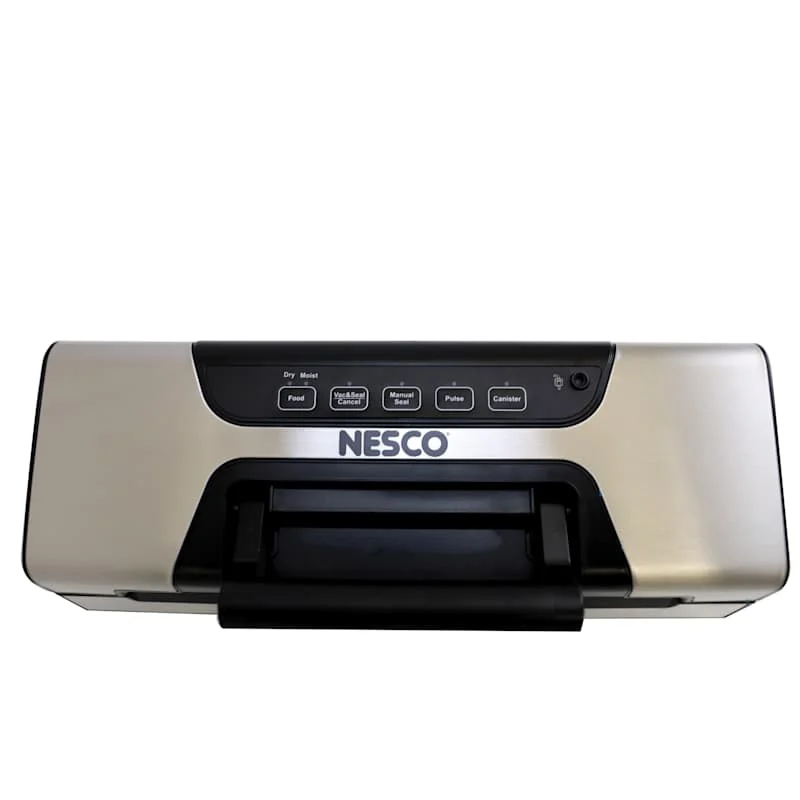
Explore this need in the finder →The NESCO VS-15S makes most sense for a household that wants to work from rolls without keeping scissors and loose material beside the machine. Its internal storage, guided cutter and front handle support that routine. Dedicated Pulse and Dry/Moist selections give it more flexibility than a basic automatic sealer, but its operating interval still calls for patient preparation.
Buy it for a roll-based routine
NESCO specifies an 11.8-inch maximum bag width and lists both rolls and premade bags in the current package. A roll helps when portions vary in length: a small serving and a long fillet do not need identical bags. The tradeoff is that cutting a length creates an open tube. You must seal its first end before filling it, and that step uses the appliance too.
The cutter sits in a guide inside the machine. Pull material through, close the guide and move the blade across it as instructed. This is different from the removable cutting tool documented for the VS-09. If cutting bags at the appliance is a firm requirement, that distinction is more helpful than comparing the word Deluxe on the two product titles.
Pulse is useful when the food needs watching
The guide describes holding Pulse to run the vacuum, releasing it to stop, and pressing Manual Seal after reaching the desired compression. That gives you a way to approach a soft item gradually. It also means this is an attended process. You are deciding when enough air has been removed; the machine cannot know the texture you want to preserve.
For routine portions, Vac & Seal runs an automatic cycle. Manual Seal can also interrupt vacuuming and begin closure. Those are related tools with different uses: the automatic route simplifies repeated ordinary bags, while Pulse suits an item whose shape you want to monitor. Neither control establishes that the result will be identical across different foods or bag sizes.
Moist food still needs a clean bag neck
The Food selector offers Dry and Moist. NESCO's linked VS-15S guide describes this selection in terms of vacuum pressure; it does not provide a numerical pressure comparison or a verified free-liquid bagging process. We therefore treat it as a dedicated moist-food setting without assigning invented pressure or timing values.
For juicy portions, follow the guide's preparation advice and keep residue out of the sealing area. Partially freezing meat is one documented approach. Do not treat a Moist light as a substitute for handling the food carefully. If your actual task is bagging cooled soup without freezing it first, the VS-22LB deserves a separate comparison because its Liquid control has a different stated purpose.
Plan around the two-minute interval
This appliance is approved for one operating cycle every two minutes, rather than continuous use. Its manual also advises cooling between uses. That makes it a better fit for a measured evening of portioning than for an uninterrupted line of bags. Put labeling, arranging filled portions and cleaning bag mouths between operations; do not assume preparation with rolls eliminates the required pauses.
The 120-watt specification is an electrical input, not a bags-per-minute rating. A useful comparison with the VS-12P should focus on its pressure choices and double-sealing documentation. A comparison with the Anova Precision Pro should consider the maker's continuous-sealing claim. None of those differences predicts which machine will remove air faster in your particular bag.
The hose is only one part of container sealing
The product includes a vacuum hose, while compatible canisters are separate. A buyer who wants containers immediately should account for that extra purchase and check compatibility. Our included-equipment canister filter does not count an empty hose connection as a complete container setup. This prevents a seemingly suitable result from arriving without the vessel the task requires.
After use, unplug, wipe and dry the machine. Keep the handle unlocked in storage to protect the gasket shape. Do not immerse the appliance or remove the protective tape over the sealing element. A dry, accessible place for the appliance and supplies is part of the ownership decision, particularly if pulling it out of a cabinet is otherwise likely to discourage regular use.
This review interprets NESCO's current VS-15S page and exact linked guide; it does not report hands-on testing. Compare sealers for moist solids with pulse and an onboard cutter, keeping the required rest interval in mind.
Key details at a glance
| Mechanism | external |
|---|---|
| Power and charging | 120 V,120 W in the exact VS-15S guide. Frequency is not inferred from another model. |
| Operating interval | One operating cycle every two minutes; not designed for continuous use. The brief manual-seal interlock does not replace the cooling instruction. |
| Supplies and accessories | Current page lists 11 by10-foot and8 by10-foot rolls, five quart and five gallon bags, and a hose. Compatible canisters are separate. |
| Care and storage | Unplug, damp-wipe and dry; do not immerse. Store the handle unlocked to protect gasket shape. |
Use the exact model’s instructions for operating limits, supplied equipment and version differences.
Sources for this assessment
Find a process that fits your food.
Combine package type, moisture and essential conveniences, then read the operating limits.