
Your needs, this model
Does it fit your priorities?
Can I seal fifteen-inch-wide textured bags on an external machine that fits a nineteen-inch body-width limit?
Yes. The exact current Pro-2100 supports bags up to fifteen inches wide and its manufacturer dimension graphic labels the body at nineteen inches. Leave extra room for the bag and open lid.
Explore this need in the finder →Does Manual Seal provide a dedicated manual pulse control?
No. It begins the sealing stage early during vacuum. It does not provide the repeated pump-burst control required by the pulse choice.
Explore this need in the finder →Does the fan qualify this model for documented continuous-batch operation?
No. The exact shared operating manual still requires at least twenty seconds between cycles with the lid open.
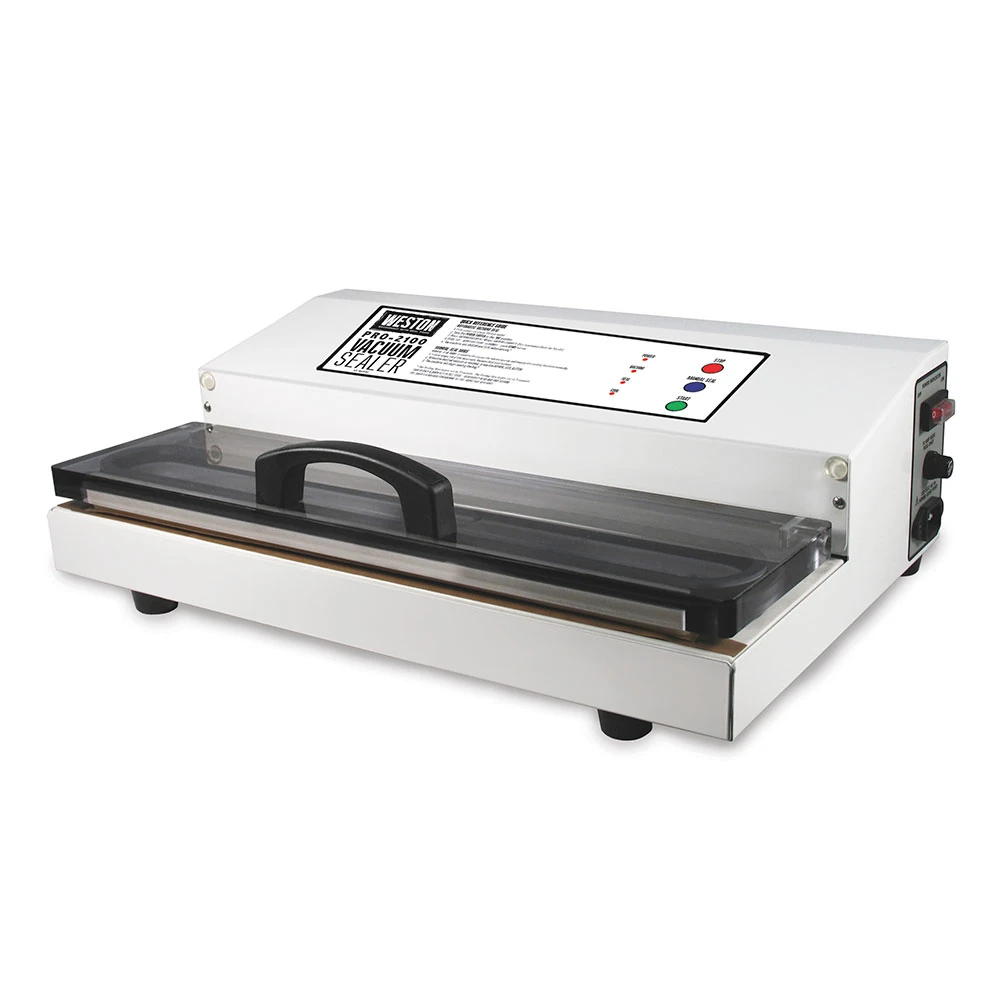
Explore this need in the finder →The Weston Pro-2100 65-0101 is a wide external vacuum sealer for someone who prepares substantial bagged portions and is willing to work through a deliberate sealing routine. Its current manufacturer material confirms bags up to 15 inches wide, a see-through lid and a Manual Seal button that can end the vacuum stage early. The important tradeoffs are its 19-inch body width, required cooling pauses and the need to keep moisture and particles away from the suction port.
Wide bags need matching worktop space
A 15-inch bag opening can be useful for wider portions that are awkward to arrange in a narrower bag. It is an opening-width limit, not a measurement of the food you can pack in every direction. Leave the manual's required headspace above the food and enough clean bag material to lie flat across the sealing area. Wrinkles and a contaminated opening can undermine a bag even when it is well within the nominal width.
The current official dimension graphic labels the body at 19 inches wide, 13.5 inches deep and six inches high. Reserve more room in front for the filled bag and above for the lid. Someone with a narrow preparation counter should compare the actual footprint with their available surface before buying primarily for the wider bag capacity.
This machine uses compatible vacuum bags with an embossed or mesh lining. Ordinary household storage bags are excluded by the instructions. For roll stock, cut a length first, seal one end in the specified position, then fill and vacuum seal the remaining opening. Do not assume that a supply of rolls, a cutter or a particular starter-bag count is included with a listing simply because the machine can use roll material.
Manual Seal is an early finish control
In automatic use, you press down on the transparent lid handle to establish the initial seal, start the cycle and release the handle when the bag begins to collapse. The machine continues toward its preset vacuum cutoff, seals and then cools the seal before releasing. The stage lights let you follow that sequence.
The Manual Seal button starts sealing before the automatic vacuum cutoff is reached. That is useful when you need to stop further compression at a point you can see. It is different from a pulse control that repeatedly runs the pump in small bursts, and it is not a user-programmable set of vacuum pressure levels. Choose it for the ability to end the suction stage and seal, rather than expecting a separate setting for every delicate food.
The manual warns against drawing liquids, powders or small particles into the vacuum port. Watch the bag and use the controls as instructed when moisture approaches the opening. A Manual Seal button does not establish a general thin-broth sealing mode. If packing cool unfrozen liquid portions is a central requirement, compare a documented chamber setup such as the Weston Pro-2500 rather than treating the two mechanisms as interchangeable.
The fan does not eliminate pauses
Weston advertises a double-piston pump and 935 W in the current Pro-2100 feature graphic. The operating manual still requires at least 20 seconds between cycles, with the lid open for cooling. The internal fan runs while the machine is switched on, but it does not grant permission to skip that interval. Plan an orderly sequence of filling, aligning and resting rather than continuously feeding bags through.
The booklet describes three seconds for sealing followed by three seconds for the cooling stage. Those stages are only part of the complete process, so they should not be read as a six-second promise for every filled bag. Vacuum time and preparation add to the job. Wait for the vacuum to release before opening the lid.
Keep the consumable parts in good condition
The manual identifies the chamber seals and protective seal-bar tape as service items. The tape is meant to remain in place during normal use; it is not packaging to peel away when unpacking the machine. Replacement instructions are provided, and the maintenance kit is listed separately. Check the exact part reference and your machine's condition before ordering replacements.
For cleaning, unplug the sealer, let it cool and wipe the external surfaces, suction channel and lid. Avoid abrasive products that can cloud the clear lid, spraying into the vent or damaging the protective tape. This is a wipe-clean electrical appliance, not a washable chamber basin. Allow the surfaces to dry before storage.
Where the archived Pro-2300 fits
The original Weston booklet explicitly covers both the white Pro-2100 65-0101 and stainless-steel Pro-2300 65-0201, with the same operating controls and consumable-part list. Weston records the Pro-2300 in its product archive. Its shared instructions are useful to an existing owner, while the current white Pro-2100 is the buying configuration assessed here. Confirm the exact model and parts before treating an older stainless unit as equivalent stock.
Choose the Pro-2100 when a wide textured-bag opening and visible early-seal control matter more than a small footprint, automatic liquid handling or uninterrupted batches. For a different external liquid-preparation workflow, compare the explicitly qualified modes on the FoodSaver Elite VS5960. For chamber pouches and liquid portions, compare the Pro-2500. The Pro-2100 is most useful when its wide-bag routine matches the preparation you actually do.
Sources: current Weston Pro-2100 product and gallery; original Pro-2100/Pro-2300 operating manual; Weston product archive.
Key details at a glance
| Mechanism | external |
|---|---|
| Power and charging | Grounded 120 V, 60 Hz mains operation. Current exact Pro-2100 manufacturer graphic lists 935 W and a double-piston pump. Cord storage does not mean cordless operation. |
| Operating interval | Automatic vacuum cutoff with an early Manual Seal override. Three-second sealing and three-second cooling stages are followed by at least twenty seconds between cycles with the lid open. |
| Supplies and accessories | Compatible embossed or mesh vacuum bags, up to fifteen inches wide on the current Pro-2100. Cut roll stock before preparing its first seal. Current retail starter-bag count is not established; the manual lists maintenance kit 08-0501-W separately. |
| Care and storage | Unplug and cool, then wipe the external surfaces, suction channel and lid. Avoid abrasives, spraying into the vent or peeling protective seal-bar tape. Never immerse or rinse under a tap. |
| Confirmed closed body width | 19 in |
Use the exact model’s instructions for operating limits, supplied equipment and version differences.
Sources for this assessment
Find a process that fits your food.
Combine package type, moisture and essential conveniences, then read the operating limits.