
Your needs, this model
Does it fit your priorities?
Can the exact 65-2061-W seal a dry portion in a heat-seal bag up to 11 inches wide?
Yes. Weston lists an 11-inch maximum bag width, and the VC03 guide documents the external Vacuum & Seal routine. Keep the bag mouth clean and leave the required sealing clearance.
Explore this need in the finder →Can I manually pulse the bag for a delicate or maker-prepared moist portion?
Yes. The exact VC03 controls include Pulse and Seal; watch the bag and press Seal when enough air has been removed. The moist-food steps do not permit free liquid to enter the channel.
Explore this need in the finder →Can the VC03 vacuum-seal cool, unfrozen liquids directly in an external bag?
No direct liquid-bag route is established. The exact guide says to freeze cooled liquids or moist food in a separate freezer-safe container, transfer the frozen food to a heat-seal bag, and keep liquid out of the chamber.
Explore this need in the finder →Does the exact model meet an essential built-in roll-cutter requirement?
That feature is unconfirmed. The manual explains making a bag from roll material but does not document an integrated cutter; unknown should not pass an essential cutter condition.
Explore this need in the finder →Can I require no cooling interval between consecutive bags?
No. The exact VC03 manual requires at least 20 seconds between cycles and directs owners to leave the lid open between bags.
Explore this need in the finder →Weston · Compact Vacuum Sealer · exact U.S. model 65-2061-W / VC03
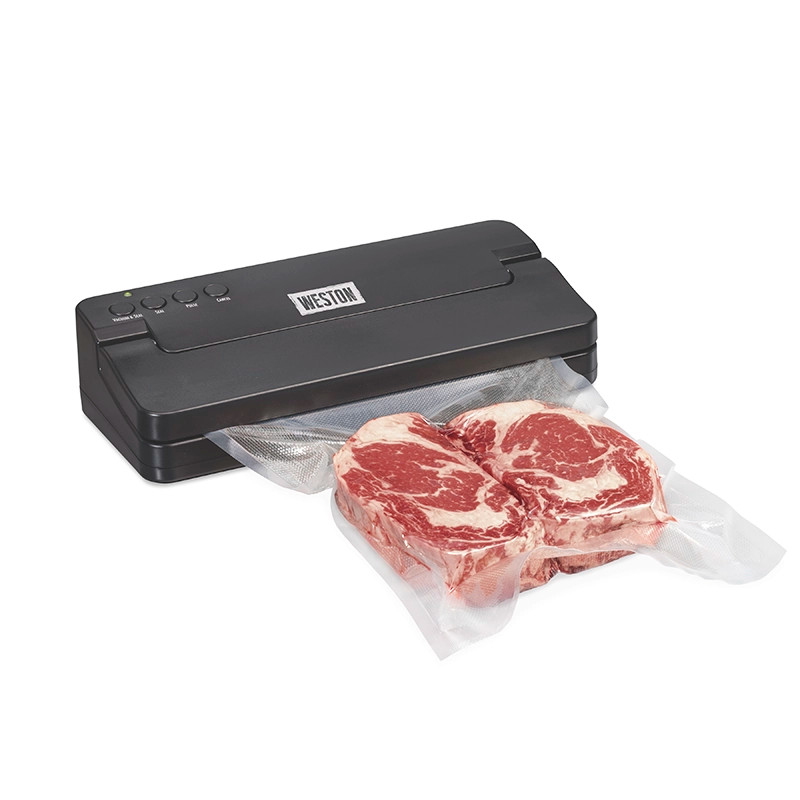
The Weston 65-2061-W is a corded external sealer for people who want ordinary textured-bag packaging without adding a roll caddy or a separate control panel full of presets. The official Weston listing identifies the compact model, states that it accepts bags up to 11 inches wide, and includes ten heat-seal bags. The matching VC03 use-and-care guide prints model 65-2061-W in its rating table. This is not a chamber machine: the bag mouth is placed in the narrow vacuum channel while the filled portion stays outside.
Four controls, but only one automatic bag cycle
The VC03 guide names Vacuum & Seal, Seal, Pulse and Cancel. Vacuum & Seal runs the usual bag operation; Seal heats a clean open edge and is also used to close a bag made from compatible roll stock. Pulse is not another automatic food setting. You press and release it while watching the bag, then press Seal when you have removed enough air. That manual control is useful when a vacuum might crush delicate items such as bread or chips, and it is a real advantage over a unit whose only option is an unattended automatic cycle.
Loading still takes care. Place the bag mouth in the vacuum chamber using the alignment guides and stop, close the lid, and press down both corners until they latch. The guide asks for at least two inches of clear space between the food and the open end. It warns against allowing liquid into the chamber and says to use heat-seal bags rather than ordinary household plastic. A smooth or wrinkled mouth, trapped food or powder, a puncture, or an unfinished end from a roll can undermine the seal; the manual's troubleshooting steps direct you to check those basics before assuming the pump has failed.
What the package does—and does not—establish
Weston states a maximum bag width of 11 inches. The VC03 parts diagram lists six quart-size and four gallon-size heat-seal bags in the package. It also shows a simple bag stop, guides, seal bar, chamber and latch-release button. The manual describes cutting roll material to length, but the exact documentation reviewed does not establish a built-in cutter or a dedicated roll-storage bay. Those features remain unconfirmed rather than being inferred from the fact that the machine can seal roll-made bags. If an integrated cutter or on-board storage is essential, compare a model whose exact manual documents it, such as the Weston 65-1641-W or Pro-1100 65-0650-W.
The manual's moist-food instructions are preparation instructions, not proof of a liquid program. For casseroles, sauces and soups it directs the user to freeze the cooled food in a freezer-safe container first, transfer the frozen portion to a heat-seal bag, and vacuum-seal immediately. For high-moisture or fragile contents, Pulse gives the operator a chance to stop before liquid reaches the machine. It does not authorize vacuuming a bag of free-flowing broth or sauce directly. If you routinely portion unfrozen liquids, the 65-2061-W is the wrong fit; the 65-1641-W has a distinct liquid routine, but its vertical-bag, fill-line and cooldown rules still matter.
Keep the pace and care routine realistic
The exact manual requires at least 20 seconds between cycles and says to leave the lid open between bags. It also gives the sealing bar time to cool if a bag is melted through and warns that too many rapid seals can overheat the machine. The specification appendix lists 120 V, 60 Hz and 100 W for the exact model. That is an electrical input rating, not a measurement of suction, speed, seal strength or continuous-batch capacity. There is no manufacturer claim here that the appliance is a production-line machine, and the documented pause is a poor match for someone who needs uninterrupted back-to-back sealing.
For cleanup, unplug the sealer and let it cool completely before wiping it with a damp cloth or paper towel. Do not immerse it. Store it with the lid unlocked; the guide cautions that leaving the locks engaged can deform the chamber seals. The hot seal-bar area also deserves care when removing a finished bag. The manual states a one-year limited warranty for products purchased and used in the United States and Canada, subject to its printed terms. Closed body dimensions and weight were not established in the exact manufacturer material reviewed, so “compact” should not be used as a substitute for a measured cabinet-clearance check.
Who should choose this exact model?
Choose the 65-2061-W if your usual job is dry portions in heat-seal bags, you want an 11-inch bag-width ceiling, and you value a hands-on Pulse option for fragile food more than an integrated roll cutter. It also handles moist solids when you follow the maker's preparation steps, including freezing where directed. Your answer changes the fit: a required Pulse control and bags at least 11 inches wide are supported; a required cutter, roll bay, supplied canister, free-liquid routine, or continuous batch is not confirmed. Unknown body dimensions should not satisfy a tight-space requirement. For more integrated roll handling or liquid-specific work, compare the exact Weston 65-1641-W; for chamber packaging, look at a chamber model and check its internal dimensions and package contents. None of those alternatives should be selected by wattage alone.
Sources: Weston’s exact 65-2061-W product page and the VC03 Use & Care guide (exact-model rating appendix and English operation section). No retail price or third-party customer-review claim is used.
Key details at a glance
| Mechanism | external |
|---|---|
| Power and charging | The exact-model VC03 rating table lists 65-2061-W at 120 V, 60 Hz and 100 W. This is electrical input, not a comparative suction, sealing-strength or cycle-speed result. |
| Operating interval | The exact VC03 guide requires at least 20 seconds between cycles and says to leave the lid open between bags. It also says to wait two minutes if rapid sealing overheats the machine; no continuous-batch capability is claimed. |
| Supplies and accessories | Weston's exact product record states that ten heat-seal bags are included; the VC03 diagram identifies six quart-size and four gallon-size bags. The manufacturer's product page supports bags up to 11 inches wide. The manual explains sizing/cutting roll material but does not establish an integrated cutter or roll-storage bay. Use heat-seal bags, not ordinary household plastic. |
| Care and storage | Unplug and let the sealer cool fully before wiping it with a damp cloth or paper towel. Do not immerse it. Store the lid unlocked so the vacuum-chamber seals are not compressed; take care around the hot seal-bar area. |
Use the exact model’s instructions for operating limits, supplied equipment and version differences.
Sources for this assessment

Find a process that fits your food.
Combine package type, moisture and essential conveniences, then read the operating limits.