
Your needs, this model
Does it fit your priorities?
Can I seal fifteen-inch bags of prepared moist solids with a body narrower than nineteen and a half inches?
Yes. The exact model supports fifteen-inch textured bags, its own graphic labels 19.1 inches of body width, and its guide gives the manual-seal precautions for moist solids. Leave extra space for loading and the lid.
Explore this need in the finder →Does this exact setup vacuum pack cool, unfrozen thin broth?
No documented route meets that requirement. The guide says to keep liquid out of the suction port and to begin manual sealing before moisture enters the channel; this is not a whole-pouch liquid chamber.
Explore this need in the finder →Can I omit bag-to-bag cooling because the motor is fan-cooled?
No. The exact current guide calls for approximately twenty seconds between bags and says to leave the lid open to cool the sealing bar.
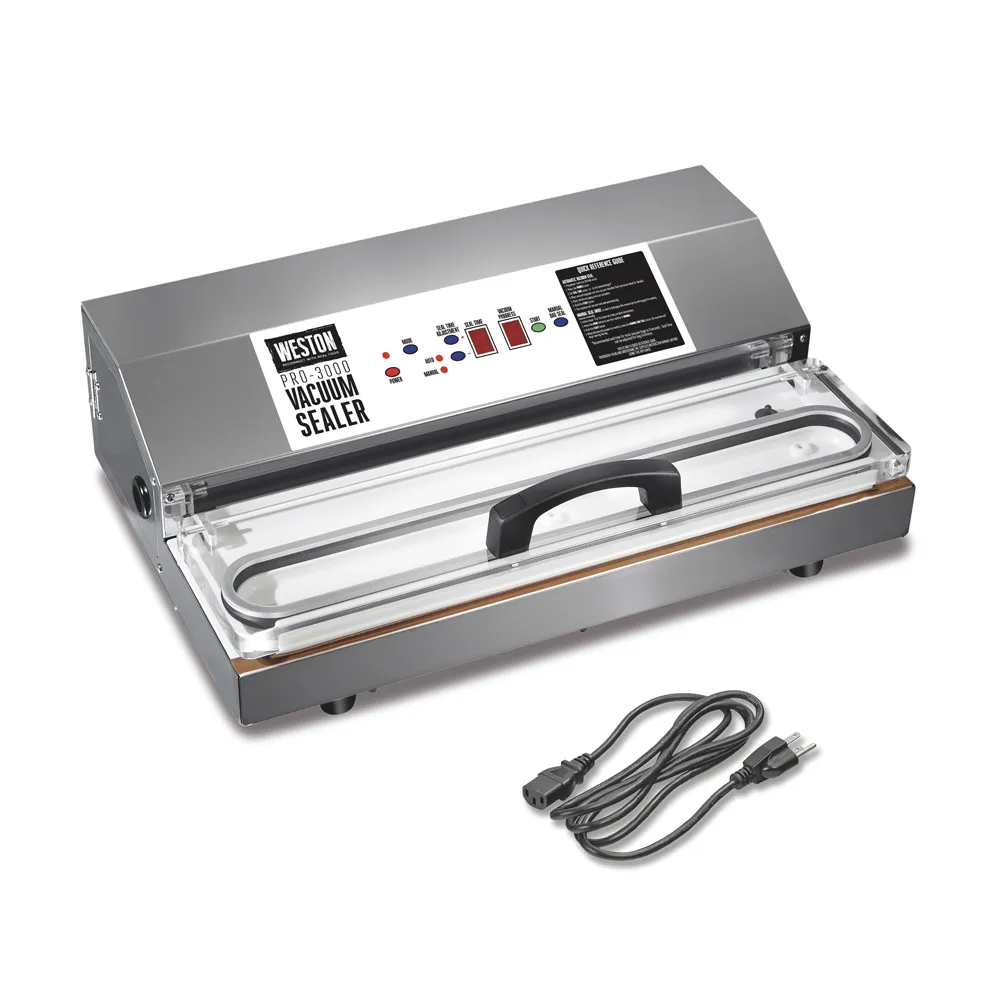
Explore this need in the finder →The Weston Pro-3000 65-0420-W is a 1020 W external sealer for compatible vacuum bags up to fifteen inches wide. Its useful features are the clear alignment lid, adjustable heat duration and a manual transition into sealing for food that needs closer watching. It is intended for household use in its exact instruction guide, despite the commercial-grade language used to describe the construction.
This is a different complete model from the 935 W 65-0401-W. The current manufacturer instructions identify type VC16 and are linked specifically to 65-0420-W. Follow that guide for the display sequence, cooling period and chamber block used during storage.
Choose it for wide textured bags
The fifteen-inch opening is useful when smaller bags are awkward for the portions you prepare. The manufacturer specifies a five-millimeter-wide heat band, which describes one wide sealing area rather than proof of a cycle producing two independent seal lines.
The exact instructions call for vacuum bags or roll material three to five mil thick, with an embossed or mesh lining for an external sealer. Ordinary household bags are outside the intended use. A smooth chamber pouch that works in another machine is not automatically suitable for this suction method.
Keep at least the instructed two inches of space between the food and the opening. A broad bag still needs a clean, flat sealing area and correct alignment in the suction channel. Leave the vacuum port unobstructed. If using roll material, prepare the length and make its first end seal before filling it; built-in cutting and roll storage are not established by this documented package.
Heat time and vacuum progress are separate controls
The heat-time adjustment changes how many seconds the sealing bar applies heat. The guide recommends an initial three-second setting and asks you to test bags, then adjust according to the seal. The seal-time display counts upward to the selected duration during that stage.
The other display advances through vacuum levels from zero to nine. Those numbers are not seconds. This distinction is useful if you are comparing the Pro-3000 with a chamber machine that offers direct vacuum-time programming: they are different controls, even when both appliances have digital displays.
Automatic mode proceeds from evacuation into sealing. In manual mode, you watch the bag and choose when to press Manual Bag Seal. The instructions explicitly say the pump continues pulling vacuum while sealing. That means early sealing can help manage moist or delicate food, but it does not freeze the bag's compression at the instant you press the button.
A dedicated hold-and-release pulse is another routine. If you specifically want repeated short bursts of suction, make that feature an essential choice in the finder rather than treating every manual-seal button as the same control.
Repetitive use still includes pauses
The fan supports repeated operation while the unit is powered on. The exact guide nevertheless calls for approximately twenty seconds between bags with the lid open so the bar can cool. Its roll-bag sequence includes about ten seconds of cooling before the vacuum release, followed by the instructed spacing between cycles.
Wait for the vacuum to release before opening the lid. During a portioning session, use the normal pause to prepare the next bag, check the mouth for creases and inspect the previous seal. A fan and an overload protector do not establish permission to remove the waiting time.
Choose this workflow if you can organize the portions around those intervals. If documented uninterrupted batch sealing is essential, compare that requirement directly rather than relying on the machine's power rating or construction description.
Moist portions require observation; broth needs another approach
The manual instructs you to keep liquid, powder and small particles out of the vacuum port. For food with substantial moisture, it calls for manually beginning the heat seal before liquid enters the channel. Adjusting heat duration for a wet food's bag is not the same as a dedicated mode for suctioning a pouch full of cool, unfrozen broth.
The Weston Pro-2500 chamber sealer is a useful comparison for that different liquid-packing requirement, subject to its own pouch placement and fill instructions. Keep ordinary refrigeration and freezing requirements separate from the fact that a bag has been vacuum sealed.
Store the supplied chamber block with the machine
The current exact dimension artwork labels the body 19.1 inches across, 12.3 inches deep and six inches high. Add room for the filled bag, the lid's movement and the power connection. The appliance's closed size is only part of the counter area needed during use.
The included chamber block has a specific storage job: the guide says to put it in the suction chamber and close the lid to avoid deforming the oval seals. Remove the block before operation and do not store other objects on top of the machine. This is a meaningful difference to check when comparing instructions or a used package.
For cleaning, unplug and cool, wipe without abrasive cleaners and protect the installed seal-bar tape. Never immerse the appliance or spray into the fan. The maintenance kit is listed separately. Choose the 65-0420-W for its documented wide-bag and adjustable-heat routine when that setup, the cooling pauses and the storage care fit your kitchen.
Key details at a glance
| Mechanism | external |
|---|---|
| Power and charging | Grounded 120 V, 60 Hz outlet operation. The exact 65-0420-W manufacturer record specifies 1020 W. A detachable power cord and cord storage do not create cordless pumping. |
| Operating interval | Choose automatic evacuation-to-seal or early Manual Bag Seal. Heat-time display counts up to selected seconds; vacuum numbers are levels, not seconds. Roll-bag cycle includes about ten seconds of cooling; allow twenty seconds between cycles and leave lid open between bags. |
| Supplies and accessories | Compatible embossed or mesh external-sealer bags or rolls, three to five mil thick, up to fifteen inches across. Cut roll stock separately. Remove supplied chamber block for use and replace it in the suction chamber for storage. Maintenance kit 08-0501-W is separate. |
| Care and storage | Switch off, unplug and cool before wiping the body, suction channel and lid. Do not immerse, rinse under a tap, spray into the fan or peel working seal-bar tape. Store the supplied chamber block in the suction chamber with the lid closed; remove it before use. |
| Confirmed closed body width | 19.1 in |
Use the exact model’s instructions for operating limits, supplied equipment and version differences.
Sources for this assessment
- Weston Pro-3000 65-0420-W exact US product page
- Manufacturer Use & Care record for 65-0420-W and its exact linked guide
- 65-0420-W original instruction guide 840378600,01/2025,52 PDF pages; cover typeVC16 and exact65-0420-W/VC16/120V/60Hz/1020W table on PDF p51.
- USDA FSIS: vacuum packaging does not remove the need to refrigerate perishables
Find a process that fits your food.
Combine package type, moisture and essential conveniences, then read the operating limits.