
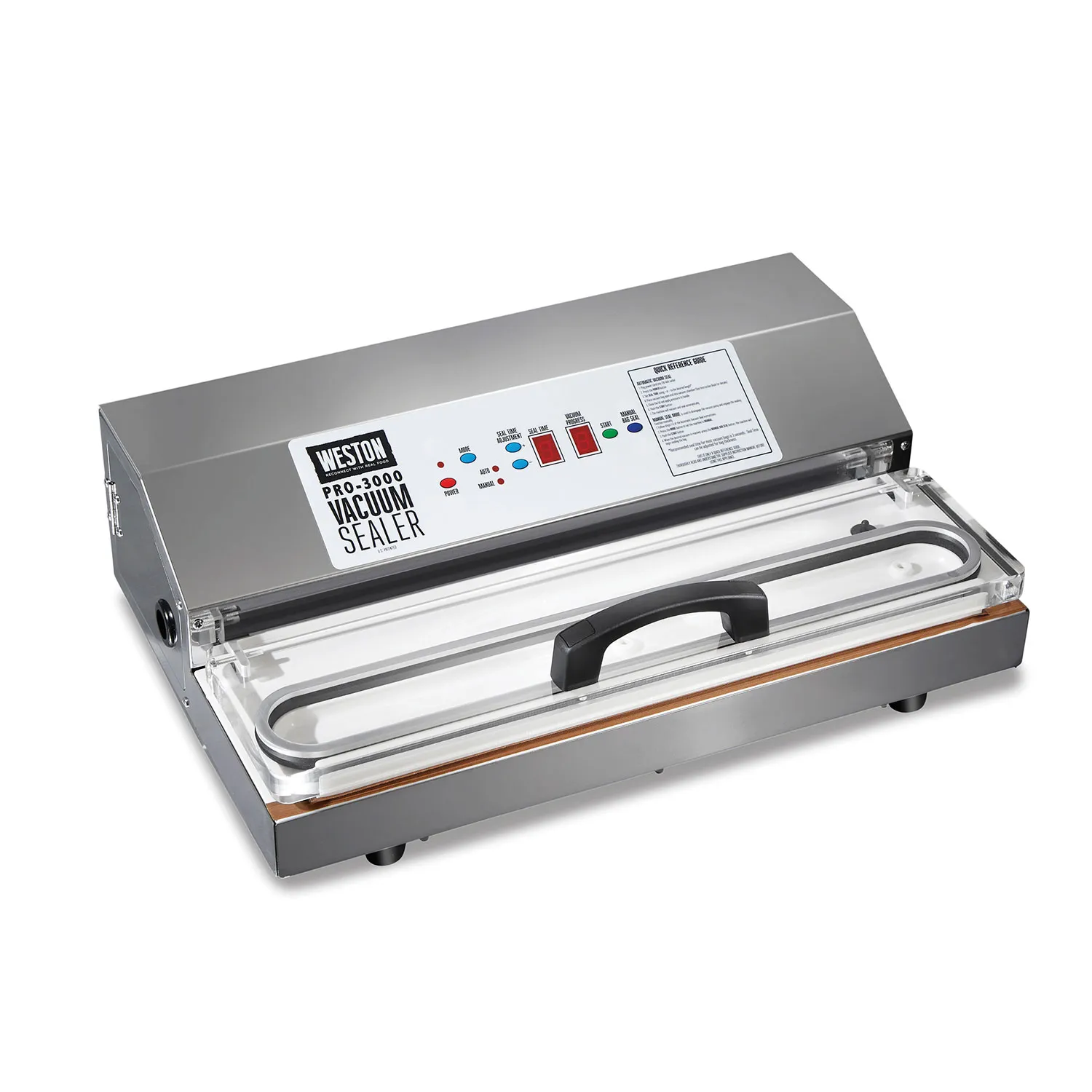
Your needs, this model
Does it fit your priorities?
Can I use fifteen-inch textured heat-seal bags for dry portions on this external machine?
Yes. This exact Pro-3000 configuration supports compatible textured bags up to fifteen inches across and operates from a grounded outlet.
Explore this need in the finder →Does the fan give me documented continuous-batch use without the stated cooling pauses?
No. The exact guide requires at least twenty seconds between cycles with the lid open, despite fan cooling and repetitive-use marketing.
Explore this need in the finder →Does Manual Bag Seal provide a dedicated hold-and-release vacuum pulse?
No. It changes from evacuation into heat sealing; the exact control layout does not provide a dedicated pulse routine.
Explore this need in the finder →The Weston Pro-3000 65-0401-W is the 935 W version of this wide external vacuum sealer. It takes compatible textured bags up to fifteen inches across and lets you adjust how long heat is applied to make the seal. It suits larger dry or prepared moist portions when you want to watch the bag, set the sealing time and repeat that setup across several packages.
Check the complete model number. The 65-0420-W Pro-3000 is a separately specified 1020 W configuration with a different instruction edition. A shared Pro-3000 name or similar stainless body does not make their timing displays, storage instructions and supplied parts interchangeable.
Fifteen-inch bags need a wide work area as well as a wide bar
The maker specifies a fifteen-inch bag opening and a five-millimeter-wide heat seal. This gives room for broader portions than a machine limited to eleven-inch bags. The number describes the bag's open edge; it does not guarantee that every bulky item fits comfortably or that a bag can be sealed with wrinkles at the mouth.
The original guide requires compatible embossed or mesh vacuum bags and keeps ordinary household bags outside the intended use. Prepare the opening so it lies clean and flat, with the instructed extra space above the food. The bag mouth must sit in the suction channel without covering the vacuum port.
For roll stock, cut the required length and make the first end seal before loading the food. The documented arrangement has a separate power-cord storage compartment, which should not be mistaken for built-in bag-roll storage. If an integrated cutter and roll holder are essential to your routine, compare the Weston storage-and-cutter model instead of choosing only by sealing width.
Program the heat application, not a vacuum duration
The two displays represent different things. In the exact 65-0401-W guide, the seal-time window shows the chosen number of heating seconds and counts down toward zero during sealing. The vacuum display advances through numbered stages up to nine. Those vacuum numbers are not elapsed seconds or a directly programmable vacuum-time setting.
Automatic mode removes air and then begins the heat seal. Manual mode lets you press Manual Bag Seal before maximum evacuation, which is useful when watching a fragile item begin to compress. This is an early transition into sealing, rather than a dedicated hold-and-release pulse button. The pump stops at the completion described in the guide, so pressing seal should not be treated as an instantaneous halt to all compression.
Test a couple of empty bags when changing bag material or heat time. The instructions explain how to reduce the time if a test seal melts through and increase it if the seal has not welded properly. Inspect the full seal line rather than assuming that a larger motor rating guarantees the right setting for every bag.
Build the cooling pauses into a batch
The fan runs while the unit is powered on, but the original instructions still require at least twenty seconds between cycles with the lid open. Their roll-bag sequence also includes a short cooling stage before the vacuum releases. Wait for that release before lifting the acrylic lid.
For a batch of portions, use the pause to position the next bag and check its opening. Leaving the lid open helps the bar cool. The manual also describes a thermal shutdown and a cooling period if overheating occurs; that protection is not a reason to omit the normal pauses.
This distinction matters if you need a machine specifically documented for uninterrupted consecutive seals. The Pro-3000's wide bar and fan can be useful for repetitive household work while still requiring the stop-and-cool routine. Choose around the whole process rather than the word continuous in a feature description.
Keep moisture out of the suction path
Moist solid food needs preparation and close observation. The guide recommends chilling or briefly firming meat and fish in the freezer to reduce the juices reaching the opening. Early manual sealing can help you manage the bag, but it is not a dedicated liquid chamber or a documented thin-broth mode.
If packing cool, unfrozen liquids is essential, compare a suitable Weston Pro-2500 chamber configuration and its own pouch and fill limits. Vacuum packing also does not replace the refrigeration or freezing the food ordinarily requires.
Allow room for setup and care
The exact manufacturer dimension graphic labels the body 19.1 inches wide, 12.3 inches deep and six inches high. Leave extra room in front for the filled bag and above for the lid. Those dimensions describe the machine, not the complete working area.
After use, switch off, unplug and allow the unit to cool. Wipe the outside, suction channel and lid without immersing the appliance, rinsing it under a tap or spraying into the fan vent. Protect the installed seal-bar tape: it is a working component, not packing material to peel off. The guide lists a maintenance kit separately and describes replacement seals and tape for the correct model.
Choose this exact 935 W configuration when its fifteen-inch textured-bag workflow and adjustable heat time fit your portions. Choose the 1020 W 65-0420-W only after comparing its own instructions and package, and choose another mechanism if reusable canisters, cordless pumping or unfrozen liquids are central to the job.
Key details at a glance
| Mechanism | external |
|---|---|
| Power and charging | Grounded 120 V, 60 Hz outlet operation. The exact 65-0401-W manufacturer record specifies 935 W. A detachable power cord and cord storage do not create cordless pumping. |
| Operating interval | Choose automatic evacuation-to-seal or early Manual Bag Seal. Heat-time display counts down; vacuum numbers are stages, not seconds. Original roll-bag sequence includes three seconds of cooling; allow at least twenty seconds between cycles with the lid open. |
| Supplies and accessories | Compatible embossed or mesh vacuum bags, up to fifteen inches across. Cut roll stock before making its first end seal. Bag-roll storage and cutter are not verified; the cord has its own storage compartment. Maintenance kit 08-0501-W is separate. |
| Care and storage | Switch off, unplug and cool before wiping the body, suction channel and lid. Do not immerse, rinse under a tap, spray into the fan or peel working seal-bar tape. Follow the exact guide for replacement oval seals and seal-bar tape. |
| Confirmed closed body width | 19.1 in |
Use the exact model’s instructions for operating limits, supplied equipment and version differences.
Sources for this assessment
Find a process that fits your food.
Combine package type, moisture and essential conveniences, then read the operating limits.